

What and why
● Sodium–glucose cotransporter 2 inhibitors (SGLT2is) are oral glucose-lowering drugs that block reabsorption of glucose in the kidneys.
● SGLT2is were initially developed as glucose-lowering drugs and were demonstrated to have beneficial effects on blood pressure and weight. Cardiovascular outcome trials and studies in people with renal disease and heart failure have confirmed significant benefits in these comorbidities, which appear to be independent of glucose lowering, with benefits on heart failure and chronic kidney disease (CKD) demonstrated in people with and without type 2 diabetes.
● SGLT2is remain underused in the UK. It is hoped the updated NICE NG28 guideline will encourage much wider prescribing, however, and it is therefore important that primary care teams have the knowledge to use these drugs safely and effectively.
Position in NICE guidance1
SGLT2is are now recommended in NICE NG28 as combination first-line therapy, alongside modified-release metformin, for most people with type 2 diabetes. The two agents should be offered from diagnosis, initiated sequentially; once metformin is titrated to the maximum tolerated dose, an SGLT2i can be started without need for a further HbA1c check.
NG28 guidance in specific groups
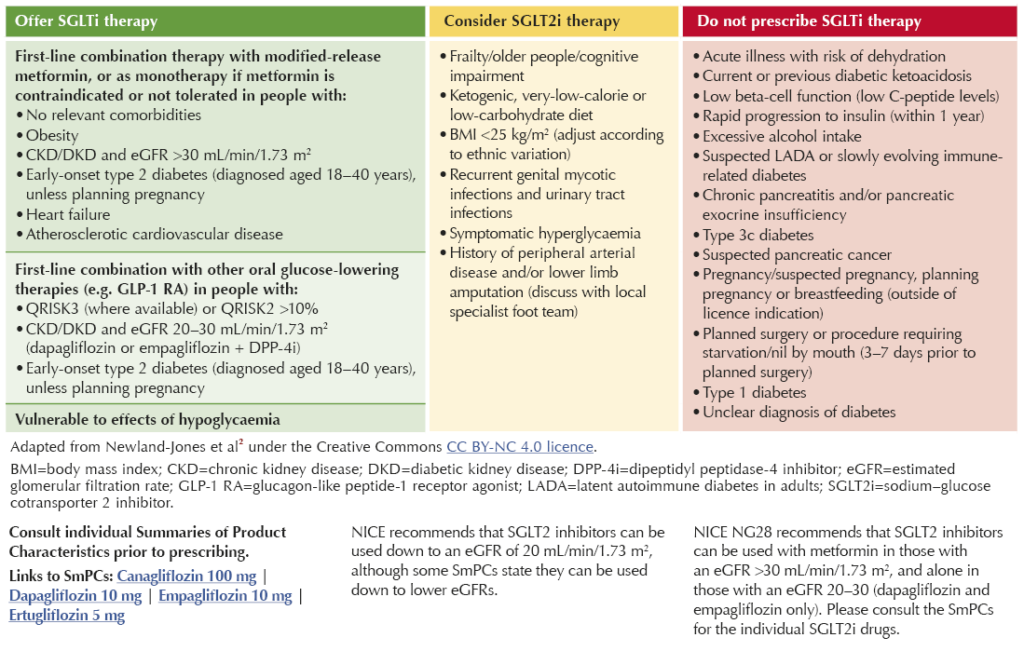
The treatment algorithm recommended by NICE varies according to which (if any) comorbidities the person has alongside their type 2 diabetes, and stratifies individuals into seven possible treatment tracks. Recommendations for initial medications in the NG28 guideline are summarised below.
● Four of the seven tracks (obesity, CKD, heart failure and no relevant comorbidities) recommend first-line dual therapy with metformin MR and an SGLT2i – but note the different recommendations in the CKD track according to eGFR.
● Two tracks (atherosclerotic cardiovascular disease [ASCVD] and early-onset type 2 diabetes) recommend an SGLT2i as part of initial triple therapy, started sequentially.
● The frailty track suggests we only offer an SGLT2i if the individual’s level of frailty does not put them at significant risk of adverse events such as hypotension.

Further detail on NICE NG28 and its implementation can be found in this At a glance factsheet.
For people diagnosed with type 2 diabetes previously, we now need to review and potentially update their medications to implement this guideline. Different teams will choose to undertake this in different ways, many choosing to counsel and add medications opportunistically at the next follow-up review, while other teams will choose to undertake searches and prioritise those at highest risk and most likely to benefit first (e.g. those with early-onset type 2 diabetes or ASCVD).
Since more clinicians will be initiating and recommending SGLT2is, and more people will be taking these drugs in all practices, this is also an ideal opportunity to ensure that all clinicians in your team are aware of sick day guidance and the need for ketone testing during acute illness in people prescribed SGLT2is, to prevent and detect DKA, even if glucose is not elevated (euglycaemic DKA).
Choosing who to treat with SGLT2 inhibitors2
Position in ADA/EASD guidance3
Updated in October 2026, the ADA/EASD consensus report recommends early use – potentially from diagnosis – of SGLT2is and/or GLP-1-based therapies, to provide organ protection and improve long-term outcomes.
Recommendations
Use SGLT2is with proven benefit in clinical studies. Can be used first-line, from diagnosis, in addition to healthy lifestyle behaviours, with or without metformin, alone or in combination with a GLP-1-based therapy.
- Glucose-lowering (High efficacy).
- Weight reduction (Intermediate efficacy).
- Established or high risk* of atherosclerotic CVD – alone or with GLP-1-based therapies according to absolute cardio–kidney risk at baseline.
- CKD – SGLT2 inhibitors should be used irrespective of albuminuria. Continue until renal replacement therapy. Can add subcutaneous semaglutide to also slow CKD progression.
- Use SGLT2i in all types of heart failure; if HFpEF and obesity, can add a GLP-1-based therapy.
- MASLD or MASH – consider SGLT2i.
- In those at high risk of atrial arrhythmias – consider SGLT2 inhibitor or semaglutide.
*High risk of ASCVD defined as age ≥55 years and two or more of obesity, hypertension, smoking and dyslipidaemia.
For more information on the consensus, see our At a glance factsheet.4
Safety concerns
Genital and urinary tract infections
● Thrush-type genital infections are common.
● Infections are more common early in treatment; providing hygiene information may improve treatment continuation.
● Treat with topical or oral treatments.
● Most people can continue SGLT2i treatment.
● Glycosuria may cause urinary symptoms and more frequent voiding.
● UTIs are relatively rare; manage with standard antibiotics. If recurrent, stop SGLT2i treatment.
Fournier’s gangrene
● In February 2019, the MHRA issued guidance on Fournier’s gangrene (necrotising fasciitis of the genitalia or perineum) following rare reports of this potentially life-threatening infection in users of SGLT2is.5
● Diabetes is also a risk factor for this condition.
● If this is suspected, the SGLT2i must be stopped immediately and the person admitted for urgent assessment.
● People should be advised to seek urgent medical attention if they experience severe pain, tenderness, erythema or swelling in the genital or perineal area, accompanied by fever or malaise.
Diabetic ketoacidosis (DKA)
● The MHRA and European Medicines Agency have issued warnings regarding a small risk of DKA, which may be euglycaemic.6,7 Discuss this prior to and during SGLT2i therapy.
- Rates in clinical trials were <0.1–0.6%, compared with rates of <0.1–0.3% for placebo, but appear higher in routine care.8
● Risk is higher:
- If relatively insulin-deficient.
- When insulin doses are reduced suddenly.
- When there is increased need for insulin (e.g. acute illness, recent surgery or alcohol abuse).
- With restricted food intake or severe dehydration.
● Symptoms of DKA include nausea, vomiting, abdominal pain, generalised malaise and shortness of breath.
● Symptoms may be atypical and glucose may not be elevated (euglycaemic DKA). Ketones (blood rather than urine) should be monitored and the SGLT2i restarted once ketones are normal and condition has stabilised.9
● Stop SGLT2i drugs during acute illness (see Sick-day guidance below) and prior to surgical procedures.
Lower limb amputations
● The European Medicines Agency advises careful monitoring of people receiving canagliflozin who have risk factors for amputation, and to consider stopping if they develop foot complications such as infection, skin ulcers, osteomyelitis or gangrene.10
● Absolute risk is low, but appears higher in those with previous amputation.
● The MHRA has advised that all people treated with an SGLT2i should receive advice regarding preventative foot care, including to inspect feet regularly and to report wounds, discolouration or pain, and to stay well hydrated.11
● Ideally avoid SGLT2is in those with active foot ulceration or previous amputation.
● People with type 2 diabetes and peripheral arterial disease (PAD) gain greater absolute benefit from SGLT2 inhibitors than those without PAD, with no increase in risk of major adverse limb events.12
Bone fractures
● A small increased fracture risk and changes in bone mineral density were seen in the CANVAS trial compared with placebo (but not in the CANVAS-R or CREDENCE trials), but were not identified in empagliflozin or dapagliflozin studies.13
● Longer-term studies have not seen a significant imbalance in fractures, dehydration, orthostatic hypotension or amputations.14
Sick-day guidance for type 2 diabetes
Blood glucose can rise during illness even if the person is not eating. When ill and at risk of dehydration, people with type 2 diabetes should be advised to:
● Temporarily stop SADMANS drugs (SGLT2is, ACEis, Diuretics [caution if diuretics being used for heart failure], Metformin, ARBs, NSAIDs and Sulfonylureas*). If unable to eat or drink, or if persistent vomiting or diarrhoea, contact their GP or specialist nurse for advice.
● If unsure how to self-manage during illness, contact their practice or diabetes specialist team, or seek emergency medical advice if unsure what to do.
● Stay well hydrated (2–3 litres of fluid per day) and eat little and often.
● If not able to eat normally, replace meals with high-carbohydrate snacks or drinks.
● Keep taking insulin and all other diabetes medicines (apart from SADMANS drugs) even if not eating.
Give people taking SGLT2is specific advice about the risk of DKA, which may be euglycaemic, and to consult if they become ill, even if blood glucose levels are not high. Primary care teams should be aware of the need to test for ketones as well as blood glucose in this situation.
*For SUs, consider stopping if unable to eat or drink, but be guided by results of self-monitoring of blood glucose.
See How to advise on sick day rules for more information.15
Safe use: SGLT2is and renal function
● Check electrolytes and eGFR prior to therapy; monitor annually unless eGFR is <60 mL/min/1.73 m2, when eGFR should be checked 3–6 monthly.
● NICE NG28 suggests SGLT2is and metformin MR can be initiated and continued in those with eGFR >30 mL/min/1.73 m2, or an SGLT2i alone if metformin is not tolerated.
- Dapagliflozin or empagliflozin can be used with a DPP-4 inhibitor in those with eGFR 20–30, or a DPP4-inhibitor alone can be offered first-line in those with an eGFR <20.
● Modest reductions in eGFR usually occur when starting SGLT2is, but extra monitoring is not required unless unwell or starting another drug likely to impact renal function.16 eGFR will usually improve and, over the longer term, SGLT2is slow progression of CKD.
● Glucose-lowering effects decrease and may be absent when eGFR is persistently <45 mL/min/1.73 m2, so additional diabetes drugs may be needed if glucose levels are suboptimal.
● SGLT2 inhibitors consistently slow the rate of eGFR decline and composite kidney outcomes regardless of CKD at baseline, and they significantly decrease acute kidney injury risk in people with CKD, cardiovascular disease and type 2 diabetes, with greater efficacy in those with higher baseline eGFR.17
Acknowledgement
The author thanks Nicola Milne for her contributions and feedback on this article.



Study identifies risk factors, potential triggers and co-occurring conditions associated with DKA.
12 Oct 2026