

The 2026 guideline takes a wider view than the previous ADA/EASD consensus reports. Beyond hyperglycaemia management, the consensus now covers holistic management of type 2 diabetes, its complications and associated multiple long-term conditions (MLTCs).
Two key areas are highlighted:
● Promoting healthy lifestyle behaviours – healthy eating, 24-hour physical behaviours (including sleep, avoiding tobacco and substance use), psychological support and weight management.
● Earlier use – potentially from diagnosis – of SGLT2 inhibitors and/or GLP-1-based therapies is recommended to provide organ protection and improve long-term outcomes.
- Earlier combination therapy with these two drug classes should be considered in people with cardiovascular disease (CVD), chronic kidney disease (CKD) and heart failure.
- Throughout the consensus, recommendations are for use of specific drugs within the classes which have proven benefit.
- GLP-1-based therapy includes GLP-1 receptor agonists and the dual GIP/GLP-1 receptor agonist tirzepatide, except where semaglutide is stated.
The terms “should” and “could” are used to distinguish between recommended and optional therapeutic guidance.
Key changes – what’s new?
● Rigorous evaluation of new evidence regarding type 2 diabetes management published in English since 2022.
● Broader focus on holistic type 2 diabetes management rather than only hyperglycaemia, including associated complications such as metabolic dysfunction‐associated steatotic liver disease/steatohepatitis (MASLD/MASH) and obstructive sleep apnoea.
● Incorporation and updating of detailed guidance on medical nutrition therapy and the “5S” 24-hour lifestyle behaviours, previously published separately.
● Focus on weight management, particularly in those with early-onset type 2 diabetes and for remission.
● Review of evidence and implementation of cardio–kidney–metabolic benefits of drug therapies.
● Early use of SGLT2 inhibitors and GLP-1-based therapies, ideally from diagnosis.
● Less certainty about the requirement for metformin first-line to support SGLT2 inhibitors and GLP-1-based therapies.
● Semaglutide recommended for people with CKD, HFpEF with obesity, and/or peripheral arterial disease.
● Consideration of semaglutide and SGLT2 inhibitors for those at high risk of atrial arrhythmias.
● Consider secondary causes such as hypercortisolism in those with apparent drug-resistant hyperglycaemia.
Overview framework
A holistic, anticipatory, integrated care approach to addressing type 2 diabetes and its associated long-term conditions, available here, includes three important considerations: complex pathophysiology, across the life course, and environmental and social determinants of health. The management overview highlights four key processes:
Improving detection and diagnostic accuracy
● Risk-based screening, including in those with overweight/obesity, to identify the 25–50% of people with diabetes who are undiagnosed.
● Diagnostic accuracy: If atypical phenotype, consider autoantibody screening or C-peptide testing. Consider alternative diagnoses, including secondary diabetes.
Integrated diagnosis and surveillance for diabetes complications and associated long-term conditions
● Longitudinal surveillance for traditional complications and MLTCs.
● Additional surveillance for obesity-related complications, physical function, psychological and mental health conditions, periodontal disease, men’s and women’s health needs, and vaccination status.
Goals of care – outcomes beyond glycaemic management
● Addressing broader care goals, including cardio–kidney protection, physical function, wellbeing and quality of life, weight management and obesity-related complications.
Holistic, person-centred interventions in type 2 diabetes
● Medical nutrition therapy, 24-hour physical behaviours (5Ss), diabetes self–management education and support programmes (DSMES).
- DSMES programmes should be offered to everyone, and self-management education should be revisited regularly.
● Evidence-based pharmacological interventions that provide management of glycaemia and weight, provide organ protection, prevent MLTCs and optimise cardiovascular risk factors.
● Prevent complications by incorporating SGLT2 inhibitor and/or GLP-1-based therapy early to modify disease and complication risk.
Therapeutic options: Healthy lifestyle behaviours, weight management and pharmacotherapy
Medical nutrition therapy (personalised dietary interventions)
Available dietary patterns and their metabolic effects are summarised here.
● A healthy-eating plan resulting in an energy deficit should be used with medications and/or metabolic surgery.
● Mediterranean, low-energy, intermittent-fasting, ketogenic and low-carbohydrate diets may help support energy deficit for weight loss.
● Recognition that no single ratio of carbohydrate, protein and fat intake is optimal for every person. Quality and quantity are important to achieve calorie deficit.
● Personalised eating patterns should be encouraged, minimising harmful foods, aiming to develop healthy, feasible and sustainable long-term dietary habits.
● Consider a Mediterranean pattern for people with atherosclerotic CVD, if feasible and acceptable.
● Consider offering intensive lifestyle therapy to achieve 10–15% weight loss and remission.
● Supplements are not recommended for glucose management.
24-hour physical behaviours
The 5S framework, previously published and now incorporated in the consensus, is summarised here, alongside actionable guidance on prescribing 24-hour behaviours:
● Standing as much as possible, Stepping, Sweating (aerobic activity), Strengthening (resistance exercise), Sleeping (quantity, quality and timing).
● Encourage resistance exercise during weight-loss interventions to preserve skeletal muscle mass and strength.
● Progressively encourage increased volume and intensity of physical activity when feasible and safe.
● Consider MLTCs and frailty when recommending physical activity.
Pharmacotherapy for treatment of type 2 diabetes
● The algorithm for use of glucose-lowering medications in type 2 diabetes has been updated. SGLT2 inhibitors and/or GLP-1-based therapies are recommended early in care to prevent complications associated with type 2 diabetes.
● Continues to highlight lifestyle behaviour therapy, DSMES and addressing social determinants of health alongside drug therapy.
● Importance of avoiding therapeutic inertia and regular reviews.
● Personalised approach, with six tracks based on individual characteristics and associated long-term conditions:
- Achieve and maintain glycaemic goals.
- Weight management.
- Atherosclerotic cardiovascular disease.
- Chronic kidney disease.
- Heart failure
- MASLD or MASH.
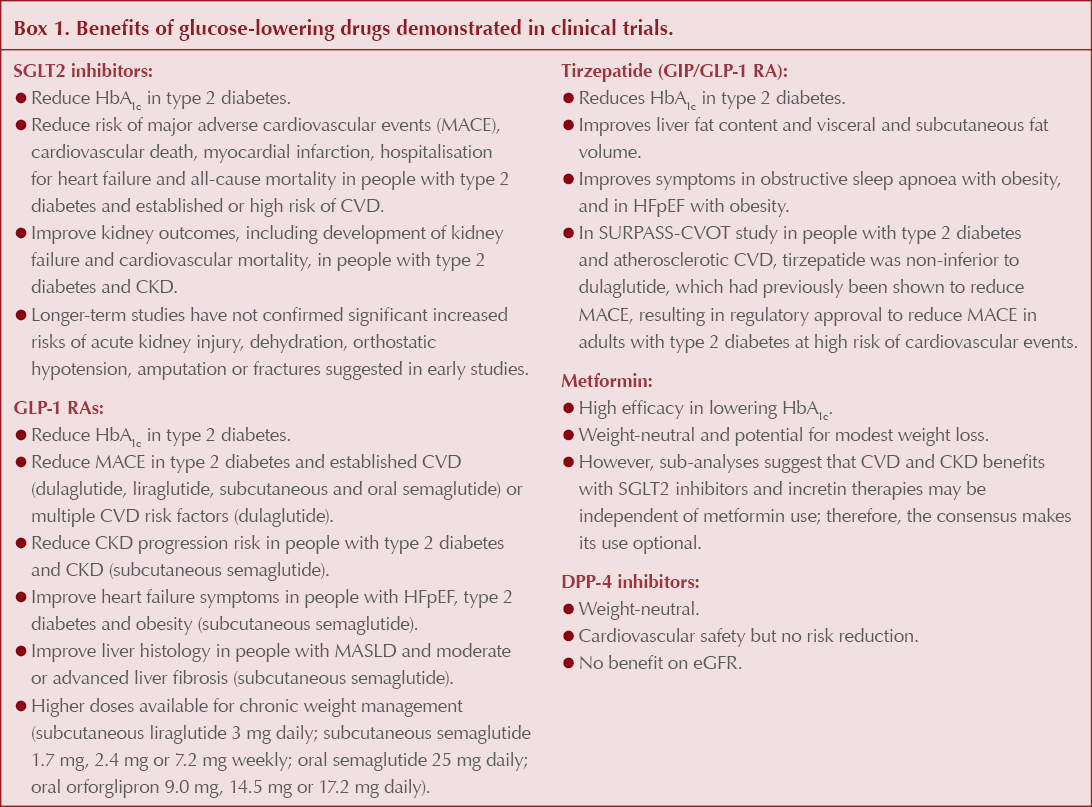
Evidence of benefits for glucose-lowering drugs are summarised in Box 1. Within the consensus report, these benefits and the clinical considerations for the different drug classes are summarised here.
Weight and body composition management beyond lifestyle interventions
● Semaglutide and tirzepatide most effective.
● Tirzepatide leads to greater weight loss but has not been compared with high-dose semaglutide (subcutaneous or oral) or orforglipron.
● Metabolic surgery could be considered for people with type 2 diabetes and a BMI ≥30 kg/m2 and should be considered for people with a BMI ≥35 (reduce BMI thresholds by 2.5 kg/m2 for people of Asian ancestry).
Personalised approach to treatment based on individual characteristics and MLTCs
This is summarised here. Note: Medication choices should not differ by race, ethnicity (although earlier initiation or intensification may be required after assessment) or sex.
Glucose-lowering therapies
● Along with DSMES and health behaviour interventions, most people will benefit from early introduction of SGLT2 inhibitor and/or GLP-1-based therapy, potentially from diagnosis.
● Choice of glucose-lowering therapy should be based on weight, other long-term conditions, adverse event profile, preferences and personal circumstances.
● When insulin is indicated (usually in addition to GLP-1-based therapies), initiate basal insulin. Maintain other glucose-lowering therapies with CVD and CKD benefits.
● De-intensify if there is hypoglycaemia risk – especially in frailty.
● Screen for secondary causes of hyperglycaemia (e.g. hypercortisolism) in adults with treatment-resistant type 2 diabetes despite multiple agents.
Cardiorenal-protective glucose-lowering medications
Cardiovascular disease:
● SGLT2 inhibitors and GLP-1-based therapies provide CVD benefits independent of metformin and should be considered first-line, individualised based on absolute cardio–kidney risk at baseline.
● If established CVD, use GLP-1-based therapies and/or an SGLT2 inhibitor, as in previous consensus.
● Combination therapy with SGLT2 inhibitor and GLP-1-based therapies could be considered in those at high CVD risk (age ≥55 years, obesity, hypertension, smoking, dyslipidaemia, albuminuria) or established CVD or CKD – irrespective of HbA1c levels.
● If peripheral arterial disease, consider semaglutide (to improve symptoms).
● If no CVD but multiple risk factors (see above), GLP-1-based therapy and/or an SGLT2 inhibitor could be considered.
● Any heart failure (irrespective of ejection fraction): SGLT2 inhibitors recommended.
- HFpEF with obesity: semaglutide or tirzepatide.
- HFpEF or HF with mildly reduced ejection fraction: a non-steroidal MRA should be used.
● CKD with albuminuria: add a non-steroidal MRA if eGFR is over 25 mL/min/1.73 m2.
● Atrial arrhythmias: semaglutide associated with a 27% reduction in atrial fibrillation risk and a 78% reduction in AV block in type 2 diabetes. SGLT2 inhibitors have anti-arrhythmic benefits and reduce new-onset atrial fibrillation compared with GLP-1-based therapy or DPP-4 inhibitors.
Chronic kidney disease:
● SGLT2 inhibitors should be used irrespective of uACR or albuminuria. Continue until renal replacement therapy.
● GLP-1-based therapies could be added to improve kidney, HFpEF and MACE outcomes; semaglutide is indicated to reduce risk of CKD progression.
● If CKD and uACR >3 mg/mmol, add a non-steroidal MRA to improve kidney and heart failure outcomes.
● Early combination therapy if CVD, CKD and heart failure.
● Choose individual SGLT2 inhibitors and GLP-1-based therapies based on:
- Country-specific availability.
- Efficacy, safety and outcome evidence.
Individualise treatment based on cardio–kidney risk and time horizon; absolute benefit is substantially greater in people at higher cardio–kidney risk.
Younger people
● Interventions targeting weight reduction are essential in early-onset type 2 diabetes.
● Early use of SGLT2 inhibitors and GLP-1-based therapies, alone or in combination, should be prioritised due to faster glycaemic deterioration and earlier onset of complications.
● Explicit counselling in women of reproductive potential regarding contraception and avoidance of pregnancy while taking these drugs.
Older people and frailty
● Medication choice should not differ in older people, but modify if appropriate for MLTCs or frailty.
● Be aware of potential for increased adverse effects of medications.
People with obesity-related conditions
MASLD and MASH:
● Weight reduction important – lifestyle interventions, including physical activity.
● Obesity, MASLD and type 2 diabetes, or type 2 diabetes and biopsy-proven MASH: GLP-1-based therapies should be preferred. Pioglitazone or tirzepatide could be used.
● Consider combination with pioglitazone and GLP-1-based therapies and continue other glucose-lowering drugs as required.
● If decompensated cirrhosis, use insulin.
● If moderate or advanced liver fibrosis (stages 2 or 3), refer to hepatology to consider treatment with a thyroid hormone receptor beta-agonist (e.g. resmetirom).
Obstructive sleep apnoea:
● If obesity, type 2 diabetes and OSA, tirzepatide or a GLP-1 RA with proven benefit could be prioritised.
Cognitive decline
● Insufficient evidence to support specific glucose-lowering drugs. Prioritise safety and simplicity.
Technology
● Consider evidence-based diabetes technologies with proven benefit in people with type 2 diabetes as adjunctive tools within a comprehensive, integrated diabetes management plan. Individualise based on clinical need, preferences and skill level.
● Consider continuous glucose monitoring in people living with type 2 diabetes, especially those on insulin.
Organisation of care
A “learning health system framework for quality and outcomes in type 2 diabetes” is recommended, summarised here.
● Healthcare systems should be organised to deliver individualised care, integrated into the daily lives of people with type 2 diabetes.
● Care should be individualised with consideration of clinical risks, personal preferences and social determinants of health, including food security, housing stability and access to care.
● Management plans should incorporate all MLTCs and be informed by overall disease burden.
● Care delivery should use innovative models, including digital health tools and interprofessional team-based care, to expand access and support self-management.
● Establish mechanisms to identify and address inequities in evidence-based care delivery, ensuring care is affordable and accessible to all.
Knowledge gaps
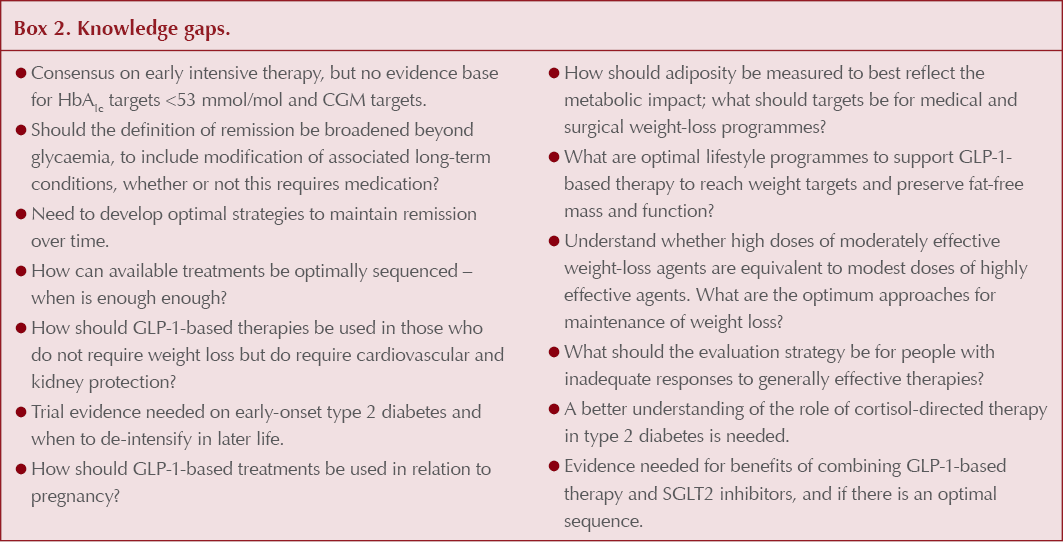
Thirteen key knowledge gaps are identified. These are listed in Box 2.




In this commentary, Kidney Research UK explores the key tests for chronic kidney disease, with information to help improve patient care.
8 Oct 2026