
The glucagon-like peptide-1 receptor agonists (GLP-1 RAs) and, more recently, the dual glucose-dependent insulinotropic polypeptide/GLP-1 (GIP/GLP-1) RA tirzepatide have emerged as highly effective agents in the management of type 2 diabetes and for weight management, regardless of diabetes status. This article, the second in a three-part series on incretin mimetics, examines their side effects, problems encountered in clinical practice, and situations in which they should be avoided or stopped. The first article reviewed the benefits of these agents in type 2 diabetes, while the third will explore their position in weight management.
Side effects
GLP-1 RAs and the GLP-1/GIP RA tirzepatide (together referred to as incretin mimetics) share a similar side-effect profile, although more information has been gathered on the GLP-1 RAs because of their longer history of use (BNF, 2026; Electronic Medicines Compendium [EMC], 2026a; 2026b).
Gastrointestinal side effects
The most common adverse effects of incretin mimetics are nausea, vomiting, diarrhoea and constipation, occurring in up to 40% of individuals using GLP-1 RAs (Manne-Goehler and Franco, 2025). Symptoms are most pronounced when treatment is initiated and generally resolve over time. When GLP-1 RAs are used to treat type 2 diabetes, real-world studies indicate that around 80% of people persist with treatment during the first year. However, discontinuation rates can be as high as 50% when GLP-1 RAs are used to manage obesity, where higher doses and cost considerations come into play (Thomsen et al, 2025).
The gastrointestinal side effects are dose dependent and can be mitigated by gradual dose escalation. If necessary, a temporary dose reduction can be implemented.
Biliary problems
Meta-analyses consistently show that incretin mimetics increase the risk of cholelithiasis and gallbladder and biliary events (Monami et al, 2017; Galli et al, 2025; Chiang et al, 2026). This risk appears to be greatest when they are used at higher doses, for longer duration and for weight loss rather than for type 2 diabetes (He et al, 2022).
Mechanistically, GLP-1 RAs induce rapid weight loss, resulting in increased cholesterol concentration in the gallbladder, while simultaneously reducing gallbladder motility and inducing stasis (Kim and Yoo, 2025). Together, these factors predispose individuals to the formation of cholesterol gallstones and their associated complications – gallbladder colic, acute cholecystitis, acute pancreatitis and acute cholangitis.
Individuals taking a GLP-1 RA or dual GLP-1/GIP RA should be advised to report persistent or severe upper abdominal pain or jaundice.
Risk of acute pancreatitis
Early clinical trials reported an increased risk of acute pancreatitis with GLP-1 RA treatment compared with placebo or comparators (Singh et al, 2013). However, subsequent meta-analyses of randomised controlled trials (RCTs) found no increased risk of acute pancreatitis in people with type 2 diabetes treated with GLP-1 RAs compared with placebo (Monami et al, 2017; Storgaard et al, 2017; Abd El Aziz et al, 2020). Similarly, a recent real-world study found no increased risk among people with type 2 diabetes and a previous episode of acute pancreatitis who subsequently received a GLP-1 RA (Lomeli et al, 2024).
It is possible that cases of acute pancreatitis observed in people using GLP-1 RAs are attributable to the development of gallstones induced by weight loss, rather than to a direct effect of the GLP-1 RA itself.
Overall, the evidence is conflicting. Recently, the MHRA issued a strengthened warning regarding the potentially fatal risk of acute pancreatitis associated with GLP-1 RAs and GIP/GLP-1 RAs, advising that (MHRA, 2026):
- If severe upper abdominal pain that could radiate to the back and be accompanied by nausea and vomiting occurs on an incretin mimetic, then the treatment should be stopped immediately and medical help sought.
- If the diagnosis of acute pancreatitis is confirmed, then the incretin mimetic should not be restarted.
In any patient presenting with these symptoms, the clinician should enquire about the use of privately prescribed incretin mimetics if these agents are not listed on the patient’s medication from primary care.
Problems associated with delayed gastric emptying
In people with type 2 diabetes and/or obesity, treatment with GLP-1 RAs appears to be associated with a greater risk of gastroesophageal reflux compared with placebo (Chiang et al, 2026). Delayed gastric emptying may lead to retention of gastric contents, increasing the risk of aspiration during endoscopic or surgical procedures. Thus, it is advisable to ensure an 8-hour fast from solids and a 2-hour fast from liquids for people taking incretin mimetics ahead of such procedures (Kim and Yoo, 2025).
Hypoglycaemia
GLP-1 RAs and tirzepatide have an inherently low risk of hypoglycaemia because their mechanism of action is glucose-dependent. However, in individuals with type 2 diabetes who are already taking a sulfonylurea (e.g. gliclazide) or insulin, then:
- Consider reducing the dose of sulfonylurea or insulin to reduce the risk of hypoglycaemia (NICE, 2026).
- Ensure that the patient is aware of the symptoms of hypoglycaemia.
Cancer risk
Animal studies have raised concerns about a possible association between GLP-1 RA use and pancreatic and medullary thyroid (C-cell) cancers. However, neither meta-analyses of RCTs (Monami et al, 2017; Abd El Aziz et al, 2020) nor real-world cohort studies in people with type 2 diabetes, including a recent study with up to 7 years’ follow-up after GLP-1 RA initiation, have supported a link between GLP-1 RA use and pancreatic cancer (Azoulay et al, 2016; Danker et al, 2024).
A systematic review of RCTs found that GLP-1 RAs had little or no effect on the risk of pancreatic or thyroid cancer, or indeed other obesity-related cancers (Ko et al, 2026). Similarly, an observational cohort study found no significant increase in thyroid cancer among individuals receiving GLP-1 RAs compared with those receiving DPP-4 inhibitors or SGLT2 inhibitors (Pasternak et al, 2024).
An important point highlighted by these studies is that, although the findings are reassuring, ongoing long-term monitoring is required given the long latency period of many cancers.
Ophthalmic complications
A significant worsening of diabetic retinopathy, defined as the need for photocoagulation or intravitreal agents, vitreous haemorrhage or new-onset blindness, was observed in the SUSTAIN-6 cardiovascular outcome trial (CVOT) comparing once-weekly semaglutide with placebo (relative risk, 1.76) (Marso et al, 2016a). This effect occurred principally in participants with pre-existing significant diabetic retinopathy who were using insulin and had high baseline HbA1c levels, rather than in those with background retinopathy. Non-significant increases in retinopathy events were observed in both the liraglutide (Marso et al, 2016b) and dulaglutide (Gerstein et al, 2019) CVOTs.
These adverse retinal outcomes have been attributed to large and rapid improvements in glycaemic control and may represent an important complication associated with incretin-based agents. No significant increase in adverse retinal outcomes was observed in the oral semaglutide CVOT (McGuire et al, 2025), but individuals with pre-existing advanced retinopathy were excluded from this trial.
In a real-world retrospective cohort study, new-onset proliferative retinopathy was more common with tirzepatide compared to controls, again occurring mostly in people with pre-proliferative retinopathy or maculopathy (Buckley et al, 2025).
In light of these findings, caution should be exercised with GLP-1 RAs or tirzepatide in people with pre-proliferative retinopathy, proliferative retinopathy or maculopathy. Discussion with the specialist ophthalmology team is advised prior to initiation of incretin mimetics (Bain, 2021; 2024). For people without significant retinopathy (including background retinopathy) GLP-1 or GIP/GLP-1 RA use is reasonable, including in those with poor glycaemic control or using insulin.
A further ophthalmic complication that requires clarification is non-arteritic anterior ischaemic optic neuropathy (NAION), in which ischaemia of the optic nerve can lead to papilloedema and blindness. Both retrospective cohort studies involving semaglutide (Hathaway et al, 2024; Abbass et al, 2025; Cai et al, 2025) and meta-analyses of GLP-1 RA RCTs (Li et al, 2026; Nogueira et al, 2026) have produced conflicting findings regarding an association between incretin-based agents and NAION. Further investigation is clearly necessary.
Loss of skeletal muscle mass
Weight loss induced by incretin mimetics is not exclusively due to loss of fat. In weight loss trials in people with obesity, the STEP-1 study found that up to 40% of the weight loss with high-dose semaglutide consisted of lean body mass, which implies loss of skeletal muscle (Wilding et al, 2021). Similar findings were reported with tirzepatide in the SURMOUNT-1 study (Jatstreboff et al, 2022).
Loss of skeletal muscle following treatment with incretin mimetics may be of particular concern in the older person at risk of sarcopenia and associated falls. To help preserve muscle mass, advise patients using GLP-1 RAs and tirzepatide to maintain good protein intake and undertake physical activity, particularly resistance exercise (Mechanick et al, 2025). These measures are also of importance after stopping incretin mimetics to encourage muscle regain (Prado et al, 2024).
Psychiatric concerns
GLP-1 receptors are located in several areas within the brain, including those involved in the regulation of mood. Reports of suicidal thoughts and self-harm in people using liraglutide and semaglutide prompted a review by the European Medicines Agency (EMA, 2023).
However, a post hoc analysis of the semaglutide RCTs in people with overweight or obesity (and with no or minimal pre-existing symptom of depression) did not show an increase in suicidality and, indeed, demonstrated a decrease in depressive symptoms compared to placebo (Wadden et al, 2024). Subsequent systematic reviews and meta-analyses have similarly found no evidence that GLP-1 RAs are associated with worsening depression or increased incidence of suicide or self-harm in people with overweight or obesity and/or diabetes when compared with placebo (Ebrahimi et al, 2025; Pierret et al, 2025).
A recent large retrospective cohort study also reported no increase in suicidal ideation, self-harm and suicide in people with type 2 diabetes using GLP-1 RAs compared with the use of DPP-4 inhibitors or SGLT2 inhibitors (Shapiro et al, 2025).
Overall, the evidence regarding the psychiatric safety of GLP-1 RAs is reassuring. Nevertheless, given the increasing use of these agents at higher doses and for longer durations, continued surveillance is essential.
When to avoid or stop GLP-1 or GLP-1/GIP receptor agonists
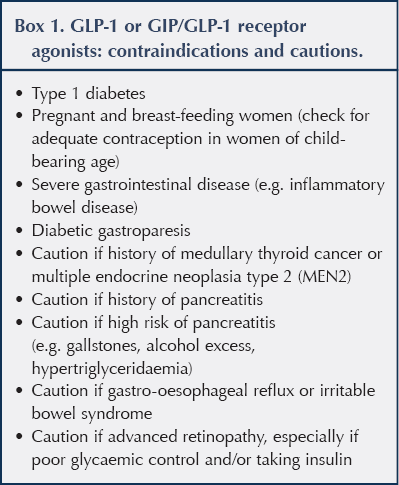
Box 1 summarises situations in which incretin mimetics should be avoided or used with caution (EMC, 2026a; 2026b). Women planning a pregnancy should observe the recommended wash-out period after stopping treatment: 2 months for semaglutide and 4 weeks for tirzepatide (Sayfi and Malik, 2026). Weight loss induced by incretin mimetics may improve fertility, including in women with polyendocrine metabolic ovarian syndrome.
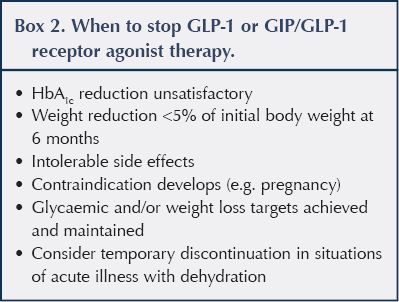
Box 2 outlines situations in which discontinuation of incretin-based therapy may be appropriate (NICE, 2026).
Counselling before incretin mimetic initiation
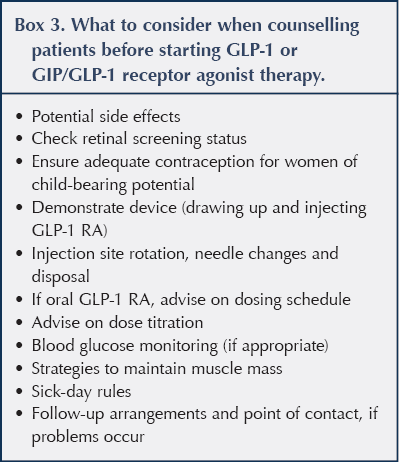
Box 3 lists the issues to consider or discuss with an individual starting GLP-1 RA or tirzepatide therapy. The importance of lifestyle change should be emphasised, and a healthcare professional should check that any other diabetes medications are being used correctly.
Women using oral contraceptives should be advised to also use a barrier method of contraception (e.g. condoms) or switch to a non-oral contraceptive method for 4 weeks after starting tirzepatide and for 4 weeks after each dose increase, because tirzepatide may reduce absorption of the contraceptive pill (EMC, 2026b).
If dehydration occurs, for example because of diarrhoea or vomiting, advise the individual to maintain a good fluid intake to reduce the risk of acute kidney injury. If dehydration is severe, consider temporary discontinuation of the incretin-based agent.
Conclusion
GLP-1 RAs and dual GIP/GLP-1 RAs have similar side-effect profiles. Gastrointestinal upset is the most common but tends to resolve with time and can be minimised by gradual dose up-titration. Incretin mimetics appear to increase the risk of gallbladder and biliary events. Although the evidence regarding acute pancreatitis is conflicting, the MHRA has emphasised the risk of this condition and its potentially serious consequences.
Incretin mimetics have an intrinsically low risk of hypoglycaemia. However, when they are added to a regimen containing a sulfonylurea or insulin, consider reducing the dose of the sulfonylurea or insulin to reduce the risk of hypoglycaemia.
Retinal screening status should be checked in people with type 2 diabetes before GLP-1 RA or tirzepatide treatment is started. For those with pre-proliferative or proliferative retinopathy, or maculopathy, an ophthalmology opinion is advisable before treatment begins. GLP-1 or GIP/GLP-1 RA use is reasonable in people without significant retinopathy, including those with background retinopathy.
Loss of skeletal muscle is an important concern when incretin mimetics are used to treat overweight or obesity, particularly in frail older people at greatest risk of sarcopenia, the natural, age-related loss of skeletal muscle mass and function. Counter measures include adequate protein intake and resistance exercise (Green, 2026).
Current evidence does not indicate that incretin mimetics increase the risk of cancers or suicidality. Nevertheless, continued surveillance is required as these agents are used at higher doses and for longer duration, and more data is accumulated.
Clinicians need to recognise when incretin mimetics should be avoided or stopped, and ensure that individuals are fully counselled before treatment is initiated.



Editor-in-chief, Julie Brake discusses how nurse-led research is important to improving the care of people with diabetes.
19 Oct 2026