

Type 1 diabetes affects approximately 10% of the 537 million people living with diabetes worldwide (International Diabetes Federation, 2021). Its management requires continual adjustment of insulin delivery in response to food intake, physical activity and current glucose levels. Because insulin requirements vary markedly from day to day, many people with type 1 diabetes do not achieve recommended glycaemic targets (Renard et al, 2021).
Continuous glucose monitoring (CGM) significantly improves diabetes care and management – randomised controlled trials and real-world studies have demonstrated improvements in glucose levels, reductions in acute diabetes complications (Polonsky et al, 2017; Riveline et al, 2022) and enhanced quality of life (Charleer et al, 2018; Yapanis et al, 2022; Gandhi et al, 2023; Speight et al, 2023). Integrating compatible CGM systems with insulin pump therapy has enabled the development of hybrid closed loop (HCL) systems. These systems use CGM glucose values to adjust insulin delivery automatically via an insulin pump and have demonstrated incremental clinical benefits beyond those achieved with CGM and insulin pump therapy alone (Crabtree et al, 2023).
The wealth of evidence supporting the clinical effectiveness and cost-effectiveness of these technologies informed the development of NICE Technology Appraisal 943 (NICE, 2023). This guidance recommends making HCL systems available to all children and young people living with type 1 diabetes; those with type 1 diabetes who are pregnant or planning pregnancy; and adults with type 1 diabetes who have an HbA1c of 58mmol/mol (7.5%) or higher or who are experiencing disabling hypoglycaemia, despite best possible management with CGM or insulin pump therapy.
Historically, access to advanced diabetes technologies in the UK has varied substantially by locality and the availability of local expertise (Rayman and Kar, 2020; NHS England, 2023). Recent national initiatives led by NHS England have sought to reduce this variation through a five‑year implementation strategy (NHS England, 2024). The strategy prioritises children and young people, pregnant women and people already using insulin pumps, in line with NICE TA943, and is supported by substantial dedicated implementation funding. Despite the availability of resources identifying accessible technologies (Kar, 2024), an urgent need remains for robust, clinically relevant and cohesive training together with assessment of clinical knowledge and skills (Rayman and Kar, 2020; NHS England, 2024). Accordingly, the overarching principle highlighted in this framework is the need for education and training to support the safe rollout of these technologies.
Although many healthcare professionals (HCPs) working in specialist diabetes services are now familiar with CGM, confidence and competence in using HCL systems are less well established. Recent national surveys of UK clinicians highlighted significant gaps in knowledge and confidence regarding HCL use, despite growth in both access and uptake (Anandhakrishnan et al, 2025; Kelly et al, 2025). Although nursing and allied HCPs often reported greater confidence and competence in supporting people living with diabetes to use these systems, findings varied according to area of practice and scope of role. This variation highlights the need to ensure that all staff are offered appropriate training, especially as more people with diabetes access these systems and require education and support (NHS England, 2024).
All clinicians responsible for diabetes care must understand the eligibility criteria for these technologies, support shared decision making when selecting a system and be able to optimise device settings to help individuals achieve their glycaemic targets. Clinicians must also be able to access and interpret data from dedicated platforms and manage common technical and clinical issues proficiently. This is particularly important because current HCL systems still require users to enter information about carbohydrate intake and activity, replace the cannula and reservoir or pod, and recognise when the system is not functioning appropriately. Failure to identify problems such as infusion set occlusion or to respond promptly to persistent hyperglycaemia (glucose >15 mmol/L) may result in diabetic ketoacidosis (ABCD and DTN-UK, 2023). Incorrect settings or delayed use of additional pump functions may increase risks of ongoing or severe hypoglycaemia, further underpinning the need for robust training and support. As adoption of these technologies increases, people using these systems are more likely to encounter HCPs working in non-diabetes specialist services. These include colleagues in primary care and community services, as well as HCPs working in non diabetes specialist areas in hospital settings, such as surgeons and general physicians (JBDS and DTN-UK, 2024). The National GIRFT reports and implementation strategies emphasise that service providers should ensure all staff have adequate training and protected time to undertake this training, enabling them to maintain competencies aligned with their job roles and responsibilities, evolving technologies and standards of care (Rayman and Kar, 2020).
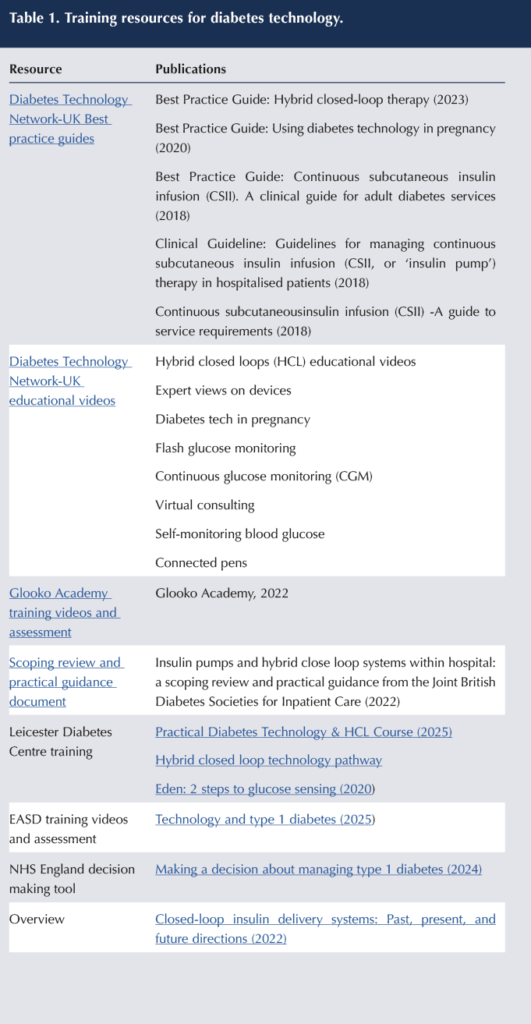
A review of available training provision across the UK identified a wide range of information resources (Table 1). However, the authors also noted that many resources were directed either at specific professional groups, such as doctors or nurses, or at people living with diabetes. This limits their accessibility and relevance for people in other clinical roles. Furthermore, despite national guidance promoting wider access to diabetes technologies and supporting implementation frameworks (NICE, 2023; NHS England, 2024), discussions in multiple national and international forums indicate that many HCPs working outside specialist diabetes teams may remain unaware of these technologies, which are now considered standard of care (NICE, 2023). They may also be unaware of the level of training required or how to access appropriate training.
While specialist diabetes teams remain responsible for ongoing management, non-specialist HCPs play a critical role in:
- Identifying people with diabetes who may benefit from these systems (and referring them to services that can support initiation).
- Recognising which diabetes technologies are available and providing basic information or support.
- Supporting people using these technologies with safety aspects of care during acute illness or hospital admission.
- Supporting basic management when these individuals cannot self-manage.
- Escalating appropriately to specialist teams.
Note: National reports have highlighted the need to improve awareness and training across the wider workforce, rather than only within specialist services (Rayman and Kar, 2020). This reflects a shift in standards of care, in which all HCPs are now expected to have at least a baseline understanding of diabetes technologies.
Aim of the National Competency Framework
A multidisciplinary working group led by experts at the Leicester Diabetes Centre designed a framework to:
- Support all HCPs in developing appropriate knowledge and confidence.
- Align training with existing national guidance and published standards.
- Provide a clear, structured pathway for learning and competency development.
- Enable services to identify training needs and improve workforce capability.
- Importantly, this framework does not replace existing education resources; instead, it helps HCPs navigate and apply them in practice.
The framework
The framework uses a four-tier model based on Benner’s novice-to-expert framework (Benner, 1982), adapted for practical use across healthcare settings.
Tier 1: Awareness
For all HCPs who may encounter individuals using diabetes technology but are not directly managing it.
Focus
- Awareness of insulin pumps, CGM and HCL systems.
- Understanding basic functions (what they do and do not do).
- Identifying people with diabetes that may benefit from these systems (and referring them to services that can support the initiation of them).
- Identifying emergencies (e.g. hypoglycaemia or DKA) and escalating appropriately.
Relevance
This level is essential for all HCPs whose primary role is not focused on supporting people with diabetes but who encounter people living with diabetes as part of their practice (e.g. all ward-based and frontline staff, primary care.
Tier 2: Competence
For HCPs who regularly care for people living with diabetes and may require competence to support these individuals in basic management decisions or with practical elements of care.
Focus
Managing common clinical situations:
- Hypoglycaemia and hyperglycaemia.
- Intercurrent illness.
- Device concerns or failure.
- Understanding when technology can or cannot be continued.
Supporting individuals using these technologies who are unable to self-manage in accordance with local and national guidance (e.g. JBDS and DTN-UK, 2024).
Relevance
This is the key level for most HCPs who spend a large proportion of their time working in diabetes services supporting people living with diabetes (e.g. in inpatient or community settings).
Tier 3: Expertise
For HCPs engaged in the active care and management of people using diabetes technology on a day-to-day basis.
Focus
- Supporting onboarding and troubleshooting.
- Interpreting glucose data.
- Adjusting therapy (within scope).
- Providing educational support (people living with diabetes and other members of the team).
Relevance
This level is for HCPs who require expertise and knowledge of details of different systems and can provide in-depth support, including on-boarding and troubleshooting, to people using diabetes technologies (e.g. members of the diabetes team).
Tier 4: Leadership
For clinical leaders involved in service development and complex care.
Focus
- Demonstrating service-level leadership.
- Demonstrating clinical-level leadership.
- Managing complex clinical situations.
- Demonstrating advanced analytical skills.
- Advanced skills in provision of education and training.
- Networking leadership and involvement.
Relevance
HCPs who have local or regional responsibilities for delivery of diabetes technology care and are involved in service development and delivery, as well as complex case management.
Focus on knowledge and skills development
The framework and affiliated assessments prioritise practical, safety-focused competencies and attempt to build on existing knowledge and skills to develop the following:
1. Recognition and basic understanding
- Identify insulin pumps, CGM sensors and HCL systems.
- Understand functions and benefits/outcomes of the systems.
2. Safe clinical management
Know how to respond to emergencies:
- Hypoglycaemia.
- Hyperglycaemia.
- Suspected DKA.
Understand the importance of:
- Blood glucose and ketone monitoring.
- Avoiding unnecessary removal of devices.
- Accurate settings (including calculations).
- Nutritional support.
- Accurate interpretation of data.
3. Escalation and communication
- Recognise when specialist input is required.
- Communicate effectively with diabetes teams.
- Follow local escalation pathways.
- Share knowledge and skills.
- Demonstrate acquired knowledge and skills.
4. Supporting patient-centred care
- Ensure culturally competent and individualised care.
- Provide accurate, up-to-date and tailored advice.
- Respect patient autonomy and experience.
- Support implementation and continuation of technology according to latest guidance and research.
- Provide safe, effective and proficient care.
Alignment with existing published guidance
The framework document has been developed to support the implementation of, rather than to duplicate or replace, existing national guidance, including:
- NICE TA943 (2023).
- NHS England (2024) 5-year implementation strategy.
- JBDS/DTN-UK (2024) inpatient guidance.
- GIRFT recommendations (Rayman and Kar, 2020).
- Best practice guidance (Griffin et al, 2023)
- Nursing & Midwifery Council (2019) and General Medical Council (2025) professional standards.
- Trend Diabetes (2024) competency frameworks.
It also draws on established educational principles and evidence-based approaches to competency assessment (Leicester Learning Institute, 2018; Center for Innovative Teaching and Learning, 2025).
Education and assessment approach
To support diverse learning needs and align these with appropriate training opportunities and authentic assessment strategies, the framework was designed to integrate a variety of learning resources that actively incorporated Visual, Auditory, Reading/writing and Kinaesthetic (VARK) principles (Fleming and Bonwell, 2019) and fostered inclusive and authentic assessment (Leicester Learning Institute, 2018; Center for Innovative Teaching and Learning, 2025). These principles were then incorporated into the assessment tools developed by Jolley et al (2026), which are available at https://bit.ly/3UfEax8.
The framework incorporates:
- Blended learning (face-to-face and digital).
- Case-based scenarios.
- Practical demonstrations.
- Knowledge checks (e.g. multiple-choice questions).
- Workplace-based assessment.
The framework (Richardson et al, 2026) and affiliated assessment tools specify the core competencies required within each level and indicate the training and educational activities needed to achieve them. They also aid the identification of appropriate assessment methods and indicate ways in which all HCPs may evidence learning within routine clinical practice. Additionally, it is hoped that the integration of a blend of face‑to‑face and virtual content delivery methods, including multiple‑choice questions, graphics and images, case‑based learning, checklists, interactive exercises and reflection, to assess competence and demonstrate transferability to clinical practice scenarios, will support the development of transferable skills and ultimately improve care delivery.
Discussion
The framework and affiliated assessment tools were conceived in response to the training gaps identified in the GIRFT report (Rayman and Kar, 2020) and are intended to address the training needs of HCPs across the workforce, supporting their development from “novice to expert” in this area (Benner, 1982). We hope that adoption of the framework (Richardson et al, 2026) and assessment tools (Jolley et al, 2026) will improve care for people living with diabetes who use these technologies in a number of ways.
From the perspective of the person living with diabetes
It is hoped these documents will increase awareness of the level of knowledge relating to diabetes technologies and expectations of levels of knowledge that different healthcare professionals may possess.
From the HCP perspective
It is hoped that these documents will help all HCPs identify the training requirements related to their roles and responsibilities and personal development plans.
Note: These documents do not necessarily suggest that all individuals will progress through the four levels of competency. For example, many very experienced clinicians already possess skills and expertise associated with tiers level 3 and 4, while others may require only tier 1 or tier 2 competencies. However, for those who want to progress, this framework is designed to help identify the knowledge and competencies they need to acquire and how they may demonstrate their achievements. HCPs will also find that their experience and knowledge within the tiers are not static. As new devices are introduced to the market, there will be occasions when further upskilling is required.
From the perspective of the healthcare provider
These documents provide a framework through which an organisation can ensure that its services include HCPs with the appropriate knowledge and skills to provide effective, safe and efficient services. Additionally, they can help organisations identify gaps between roles and competencies, thereby directing staff to the right training opportunities.
The framework and associated assessment tools also have value for providers of training in diabetes technology, as they support trainers in tailoring education to competency levels aligned with HCPs’ roles and responsibilities. For example, the training required for a nurse in primary care might differ from that required for a nurse working exclusively within specialist services, depending on their respective roles and responsibilities. The authors believe that the main strength of these documents is that they are the first published resources that explicitly identify the level of competence required for different roles and responsibilities within services, helping to identify training requirements and suggesting ways in which these competencies can be assessed and attained. The endorsement and affiliation by leading professional bodies (see left) support their face validity.
Following publication in April 2026, it is hoped that the adoption and impact of the framework and the affiliated assessments will be evaluated through collaborations with national audit requirements. This will allow assessment of current gaps in knowledge and skills, as well as its influence on service delivery and implementation outcomes. It is also anticipated that the framework will help shape existing educational resources across industry and other providers, ensuring that training is targeted, clinically relevant, and supported by appropriate assessment of knowledge and skills
Conclusion
As more people access CGM and HCL systems, all HCPs will increasingly encounter these technologies in everyday practice. This competency framework and the affiliated assessment tools provide:
- A clear structure for training and development.
- Support for safe, consistent care delivery.
- Alignment with national standards and published guidance.
- Links to national assessment tools aligned with competency framework.
Ultimately, improving awareness and competence amongst all members of the HCP team will help ensure equitable, high-quality care for people living with diabetes across all healthcare settings (NICE, 2023).
So, are you ready? Would you be able to demonstrate your competence and confidence using these devices? How would your services compare to others?
Affiliations
- University of Leicester
- University Hospitals Leicester
- Breakthrough T1D,
- Diabetes Technology Network
- King’s College Hospital.
- Diabetes UK
- Diabetes Specialist Nurse Forum.
- Trend Diabetes
- Royal College of Nursing




Editor-in-chief, Julie Brake discusses how nurse-led research is important to improving the care of people with diabetes.
19 Oct 2026