

Obesity and dietitian societies issue joint guidance on safe use of incretin therapies for weight management
A new consensus statement with recommendations for safe and effective use of incretin drugs in obesity therapy was presented at the Congress. The joint statement, from the European Association for the Study of Obesity (EASO), European Federation of the Associations of Dietitians (EFAD) and the European Collation for People living with Obesity (ECPO), covers a wide range of issues connected with obesity drugs, including:
Medical nutrition therapy (MNT)
MNT, delivered by a registered dietitian, is central to obesity care and includes reinforcing healthy dietary patterns and facilitating long-term behaviour change; advice on protein, fibre, vitamin and mineral intake; and eating patterns to minimise gastrointestinal side-effects.
Physical activity and exercise
Any physical activity will help with both weight loss and prevention of weight regain, as well as helping general and mental health. Alongside aerobic exercise, muscle-strengthening (resistance) training is crucial to help reduce lean body mass loss.
Nutritional psychology
Screen for and monitor mental health issues, which are common in people with obesity, and screen for alcohol use disorders before starting incretin therapy.
Monitoring body composition and functional capacity
Move beyond BMI alone by assessing central adiposity (waist circumference or waist-to-height ratio) and pragmatic measurements of muscle function (e.g. adjusted handgrip strength or sit-to-stand test). Pragmatic targets, where body composition data are available, are an approximate 3:1 ratio of fat loss to lean mass loss. Dual-energy X-ray absorptiometry or bioelectrical impedance analysis are recommended for body composition measurement if available locally, where costs allow, and particularly for individuals at higher risk of sarcopenia.
Socioeconomic considerations
Obesity disproportionately affects minority ethnic groups and lower socioeconomic populations, who also have reduced access to specialist services in the UK. Policies should expand drug coverage and address stigma, while clinical services should improve access to dietitian-led MNT, which could reduce inequalities, improve adherence and outcomes.
The consensus was published in The Lancet Diabetes & Endocrinology. It is reviewed in greater detail in Diabetes Distilled.
GLP-1 RAs are safe and effective for weight loss in children
A systematic review and meta-analysis of randomised controlled studies, including nine studies involving 756 individuals, demonstrated that GLP-1 receptor agonist use for weight loss in children of various ages, without diabetes, is safe and effective. The analysis, presented as an oral poster by Dr Manpreet Kaur Oberoi (University of Western Ontario, Canada), included three trials of exenatide, five of liraglutide and one of semaglutide.
Mean age of the participants was 14–15 years, with a range of 6–18 years, as specialists often use the drugs off-licence in younger children. Mean weight loss across all ages and weights was around 5 kg, with semaglutide demonstrating the most pronounced weight loss (17.75 kg). Weight, BMI, blood pressure and quality of life scores improved in the treated adolescents, and heart rate reduced rather than increased.
The only significant safety concern was nausea, which was three-times more common in those receiving GLP-1 RAs compared with those given placebo. Serious adverse events, including pancreatitis, gallstones and appendicitis, were rare.
Dr Oberoi called for larger, longer studies to confirm sustained efficacy, optimise dosing strategies, evaluate long-term safety and assess patient-reported outcomes more thoroughly.
The GLP-1 RAs Saxenda (liraglutide 6 mg) and Wegovy (semaglutide 2.4 mg) are licensed for use by specialist teams in children aged 12 years and older in many countries, including the UK.
GLP-1 RA obesity drugs are associated with reduced systemic inflammation beyond weight loss effects
A meta-analysis of ten randomised controlled trials involving more than 23,000 participants demonstrated that GLP-1 receptor agonist obesity drugs are associated with reductions in systemic inflammation, as measured by high-sensitivity C-reactive protein (hsCRP), beyond that which would be expected by weight loss effects alone.
GLP-1 RA therapy was associated with a significant 45% reduction in hsCRP compared to placebo, with reductions of around 48% in those with obesity and weight-related comorbidities, 38% in those with heart failure with preserved ejection fraction, and 38% in those with established cardiovascular disease (CVD). There was no difference between semaglutide or tirzepatide in this study.
The authors, including Dr Mario Torres Chavez (Instituto Nacional de Cardiología – Ignacio Chávez, Mexico City), who presented the poster, concluded that GLP-1 RAs used for weight loss in people without type 2 diabetes have a significant impact on reducing systemic inflammation, and that this supports inflammation modulation as a contributing mechanism to the CVD benefits of GLP-1 RAs, in addition to their impact on blood glucose and weight.
Raised cardiovascular disease risk even in people with “preclinical obesity”
Both people with clinical and preclinical obesity, as defined by the Lancet Commission on Obesity framework, are at increased risk of developing cardiovascular disease (CVD), according to a study using UK Biobank data presented at the Congress.
The study evaluated 382,769 adults, of white ethnicity, aged 40–69 years, none of whom had CVD at baseline. Lancet Commission criteria were used to classify excess body fat/adiposity:
- BMI ≥40 kg/m2,
or - BMI ≥25 kg/m2, and
- Waist circumference >88 cm (women) or >102 cm (men), or
- Waist-to-hip ratio >0.85 (women) or >0.90 (men), or
- Waist-to-height ratio >0.50 (women and men).
Of the total cohort, 285,190 had excess adiposity based on these criteria, and of this group 36% had preclinical obesity (excess adiposity but no long-term obesity-related conditions or functional impact) and 64% had clinical obesity (established obesity-related conditions).
Over 12 years of follow-up, there were 41,742 new cases of CVD and 8832 cardiovascular deaths. As shown in Table 1, compared to participants without excess adiposity at baseline, CVD and cardiovascular mortality rates were higher both in those with clinical obesity and in those with preclinical obesity.
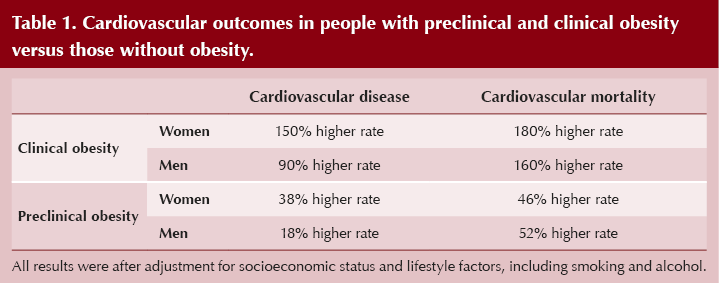
The more central adiposity markers (i.e. waist circumference, waist-to-hip ratio and waist-to-height ratio) individuals had in the “high-risk” range, the more likely they were to develop CVD. For example, a woman with one waist-based measurement in the high-risk range was 17% more likely to develop CVD than a woman with no high-risk waist measurement, while having all three high-risk measurements increased risk by 64% compared to those with none.
The Lancet Commission classification into preclinical and clinical obesity has previously been challenged as it may cause clinicians and people living with preclinical obesity to believe that this is a benign condition and, thus, not actively manage it (European Association for the Study of Obesity, 2025). Presenting the poster results at the Congress, Estefania Fuentes Avalos (University of Glasgow) highlighted the importance of preclinical obesity as a critical opportunity to improve heart health, and stressed the benefits of routinely measuring waist-based markers of central obesity, not just BMI.
The researchers calculated that early intervention, including in those with preclinical obesity, could prevent 45% of new cases of CVD and 41% of cardiovascular deaths in similar populations.
Ultra-processed food contributes significantly to cardiovascular disease and deaths
A Canadian study presented at the Congress suggests that 23–38% of all cardiovascular deaths and 23–37% of all cardiovascular disease (CVD) cases in Canada are attributable to ultra-processed food (UPF) consumption. The study used a comparative risk assessment model to estimate the burdens of incident heart disease and stroke, cardiovascular deaths and disability-adjusted life-years (DALYs) related to CVD which could be attributed to UPF dietary patterns in adults aged 20 years and older.
In 2015, around 43% of Canadian adults’ total daily energy intake was from UPFs. The model estimated that, in 2019, between 23% and 38% of coronary heart disease and stroke were attributable to UPF consumption; this translated to between 10,600 and 17,400 CVD-related deaths. Modelling scenarios suggested that if UPF intake had been reduced by 50%, this could have prevented between 5000 and 8300 deaths.
Presenting the study, Dr Virginie Hamel and Dr Jean-Claude Moubarac (Centre for Public Health Research, Montreal University) highlighted that UPFs dominate the Canadian food environment, as they do in many countries, and may account for a substantial and potentially preventable contribution to the CVD burden. Their findings indicate the need for a significant change in dietary patterns to prevent and improve cardiometabolic outcomes. They concluded that public health and individual education alone was unlikely to achieve such reductions, and that broader environmental and policy support would be needed, including food taxes, front-of-package labelling, marketing restrictions and reformulation targets to improve food quality, which have been beneficial in other countries.
The study was simultaneously published in the American Journal of Preventive Medicine.
Excessive gestational weight gain is associated with increased maternal complications risk at all pre-pregnancy weights
A Canadian retrospective cohort study of more than a million singleton pregnancies suggests that excessive gestational weight gain is common and is associated with significantly increased risk of serious complications, regardless of weight status prior to pregnancy.
Institute of Medicine recommendations propose the following weight gain targets in singleton pregnancies:
- 28–40 lbs (12.7–18.0 kg) for underweight women.
- 25–35 lbs (11.4–15.9 kg) for women of normal weight.
- 15–25 lbs (6.8–11.4 kg) for women who are overweight.
- 11–20 lbs (5.0–9.1 kg) for women living with all classes of obesity.
Applying these targets, the authors found that 18.6% of pregnancies had inadequate, 28.6% adequate and 52.8% excessive gestational weight gain. Overall, 1.46% of pregnant women (3 in every 200) suffered severe maternal morbidity (SMM), defined as potentially life-threatening complications during the perinatal period with long-term physical and mental consequences, including major haemorrhage or sepsis.
Compared with adequate weight gain, excessive gestational weight gain was associated with increased risk of SMM across all pre-pregnancy BMI categories:
- Underweight: 33%
- Normal weight: 24%
- Overweight: 16%
- Class I obesity: 21%
- Class II obesity: 28%
- Class III obesity: 24%
Having pre-pregnancy conditions, such as diabetes or hypertension, alongside excessive gestational weight gain had a disproportionate impact on SMM risk, greater than for each factor alone. For example, a women with normal weight and diabetes who had excessive weight gain had almost three-times the risk of SMM compared to a women with normal weight, adequate weight gain and no other condition.
Inadequate gestational weight gain was also associated with increased SMM, predominantly in those of normal pre-pregnancy weight (13% increased risk) and overweight (19% increased risk).
Presenting the poster findings, Associate Professor Laura Anderson and PhD candidate Sahar Khademioore (McMaster University, Hamilton, Ontario) concluded that excessive gestational weight gain can result in severe maternal complications in all women. Achieving healthy pregnancy weight gain is now known to be important for all pregnant women, not just those with higher pre-pregnancy BMI. They call for more resources to support healthy pregnancy weight gain and, thus, improve outcomes for mothers and babies.




How target-driven care can perpetuate diabetes stigma, and how targets should be framed, interpreted, discussed and acted upon.
6 Oct 2026