Diabetes foot screening was introduced in Scotland in 2006 as part of a comprehensive national Diabetes Foot Action plan. It included the introduction of foot risk stratification – low, moderate or high risk, depicted as a traffic light (Figure 1). Screening was conducted annually. A national database, SCI Diabetes, was established to record the outcomes with the aim of providing standardised testing and data recording, thereby helping to identify those most at risk of lower limb complications in order that services could target prevention strategies. The foot screening tool was later modified to include a sub-division of high risk/in remission for those with a history of ulceration, and a further category of active foot disease for those with a current foot ulcer.
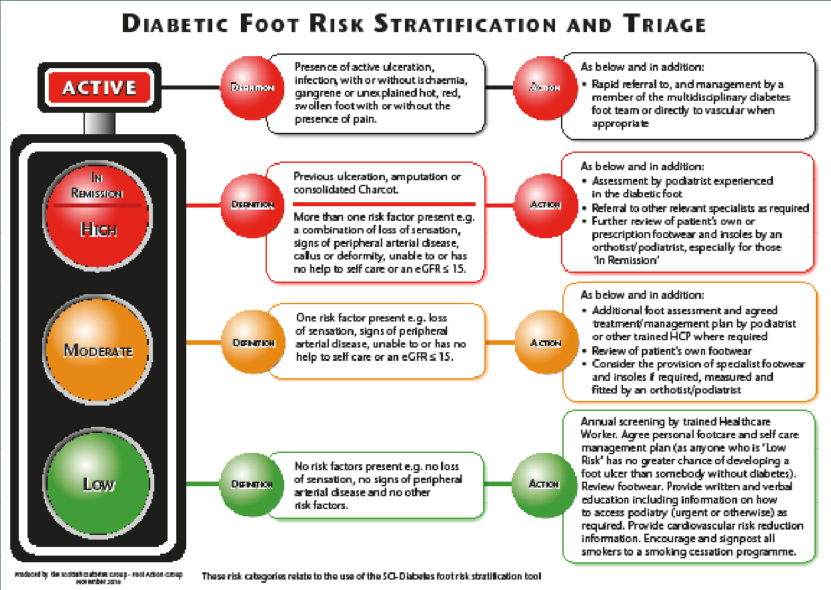
After review (Heggie et al, 2020), the Scottish Diabetes Foot Action Group made further changes to the foot risk stratification guidance (Leese and Stang, 2022). Screening requirements changed to every 2 years for low risk, while moderate risk still required an annual review by a trained healthcare professional. Those categorised as moderate risk require an initial assessment by a podiatrist, which could be a one-off, so that a tailored individual preventative care package can be developed in conjunction with the individual and/or their carers. Those in the high risk and in remission groups require regular podiatry input with implementation of an individualised care plan and clear pathways for managing general care as well as any escalation guidance for deteriorations. People in this group do not require an annual review as their status will never regress. A new foot surveillance tool was developed for use on SCI Diabetes to give a more detailed and accurate recording of the at risk populations. The changes were approved after consultation with the Scottish Government, Scottish Diabetes Group and Diabetes Scotland. Crucially, it was also agreed by the Podiatry Managers Group for Scotland that NHS podiatry services would accept the duty of care for those who are high risk and at ensure at least a one-off review for those newly identified as moderate risk.
The Scottish Diabetes Survey 2024 reported that NHS Fife had a diabetes population of 26,764 (Scottish Diabetes Group, 2024). A search of SCI-Diabetes in April 2024 identified 4,320 people “at risk”of ulceration or amputation in Fife, but only 40% of this group had received a diabetic foot surveillance check in the previous 15 months (internal data). Within this population, it was recognised that there was a sub-group of individuals living in care and nursing homes (collectively referred to as “care homes”), for whom it was even more unlikely to have had diabetes foot surveillance within the recommended timescales. This could leave them at increased risk of foot ulceration and the poor outcomes associated with it.
Aim
A pilot project was planned to carry out diabetic foot surveillance within a section of the care home population to identify risks and needs with a view to implementing a Fife-wide podiatry programme. Scan the QR code to find out more about the training programme.
Method
Every resident in a Fife care home who had diabetes was added to a database. The database was registered as an information asset on the NHS Fife Information Asset Register.
The data recorded included: name of the care home, resident’s Community Health Index number, age, sex, type of diabetes, the date of the most recent diabetic foot screening or surveillance and its outcome (no previous record; low, moderate or high risk; or active foot disease), dementia status, outcome of the 2024 diabetic foot surveillance and the date it was carried out, if the diabetic foot surveillance resulted in a podiatry intervention and what this was, and if a further podiatry appointment was required.
Diabetic foot surveillance was undertaken over a 31-week period. This was carried out in two ways: targeted visits to specific care homes where all residents with diabetes were reviewed and ad hoc surveillance when attending a resident with diabetes for pre-arranged podiatry treatment. The data collection approach was dictated by available time, while also managing a caseload. Three podiatrists were involved in the data collection process, though due to clinical pressures and other work-related commitments, one podiatrist completed the majority.
Every diabetic foot surveillance was recorded on the SCI-Diabetes database. Dementia status was recorded and noted in the clinical comments section. Where there was a specific podiatric need identified during the foot surveillance, e.g. ulceration, this was managed at that visit and a future plan was put in place.
Outcomes of each assessment were shared with care home staff verbally and as a written individualised care plan, and links were supplied to relevant online training and information resources.
Results
The baseline database showed that there were 397 residents with diabetes in 74 care homes throughout Fife, and 93% of these residents had not had a diabetic foot assessment within the previous 12 months. During the data collection period, 31 care homes with 176 residents were visited. Within this population, 16% had died since the database was compiled. In total, 148 residents received a diabetic foot surveillance check. There were 82 women and 66 men with an age range of 58–100 years (mean 83 years). Five residents had type 1 diabetes and 143 had type 2 diabetes.
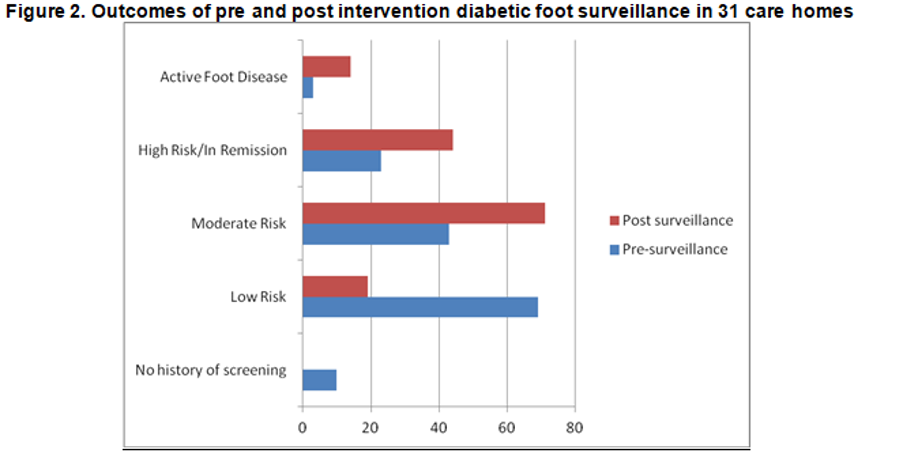
Baseline data identified risk categories as: 47% low risk; 29% moderate risk; 15% high risk; 2% with active foot ulceration; and 7% had never had a diabetic foot check.
Post surveillance, there was a significant reduction in the number of low risk, down to 13%, while those at moderate risk increased to 48%. The number of residents categorised as high risk doubled from 15% to 30% while those with active foot disease more than quadrupled with an increase from 2% to 9% (Figure 2).
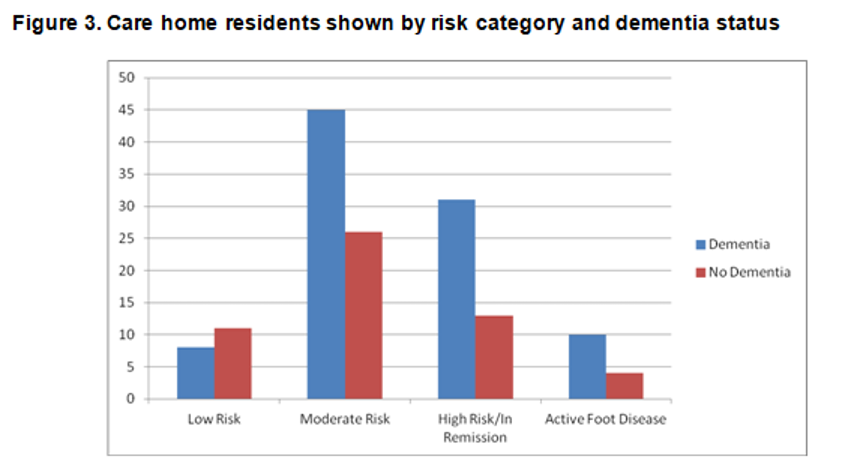
Out of those reviewed, 55% also had dementia. This sub-group were more likely to be at moderate or high risk for developing foot ulcerations than the group with no dementia and diabetes (Figure 3).
The Foot Surveillance and Management Tool within SCI-Diabetes records data in four categories in order to establish foot risk. These are: neuropathy, vascular, significant structural variation/callus and self-care. Dementia status, in relation to foot stratification risk, is not considered; therefore, it could only be recorded within the clinical comments section.
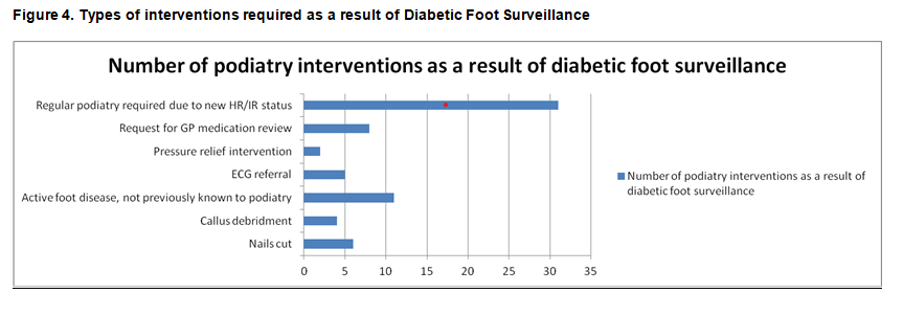
Additional interventions required as a result of the diabetic foot surveillance findings are shown in Figure 4. Of note, 31 residents not previously known to the podiatry service required regular follow-up due to their change in status to high risk/in remission and 10 people not previously know to the podiatry service were found to have an active foot wound.
Discussion
Risk status compared with general population
The Scottish Diabetes Survey (2024) reported that 87% of people with diabetes had low risk foot score with the remaining 13% as moderate or high risk or active foot disease. In comparison, care home residents in Fife had a 13% low risk foot score, with the remaining 87% being moderate or high risk or active foot disease. The dataset had limitations with just over two-fifths of the total care home population seen; however, this comparison highlights how vulnerable care home residents are, the potential impact their management could have on NHS podiatry resources and why it is necessary for robust strategies to manage the foot health of every care home resident with diabetes.
Strategies for managing foot health
In this study, the number of care home residents with moderate risk and high risk/active foot disease increased by 28 and 32 respectively. Extrapolated to those with diabetes living in care homes throughout Fife, this represents an extra 63 residents at moderate risk who would require at least a one-off podiatry visit in a year and an additional 73 residents who are high risk or have active foot disease, who would require ongoing podiatry input.
The number of podiatrists in Scotland, and the UK generally, is declining (Price et al, 2024), and NHS Fife podiatry services are no exception. NHS Fife podiatry has a dedicated care home team, yet despite this, pressures of managing the normal caseload and undertaking diabetic foot surveillance, was the main driver for the relatively small dataset.
Care home admission is usually the result of a decline in general health and mobility and the ability to self-care. As well as diabetes, other common comorbidities include dementia, stroke and neurodegenerative disease and frailty, which can increase the risk of diabetic foot complications. The diabetes care home population is unique compared with those living in the community because they have constant access to trained carers who, if educated and supported appropriately can prevent the risks associated with diabetic foot ulceration and seek immediate help when a problem is identified.
There is a lack of published research on care home populations with diabetes. However, Housley et al (2008) recommended that regular and ongoing training for care home staff on diabetic foot care, how to identify potential foot problems and when to refer to the podiatry team would help to reduce the incidence of diabetic foot ulceration. With this in mind, an alternative approach to managing diabetic foot surveillance and podiatry input in care homes could provide a solution to the conundrum of preventing diabetic foot ulceration amidst constraints within the podiatry resource.
Diabetic foot risk stratification
The SCI-Diabetes database is an excellent resource for those working in diabetes care in Scotland; however, it is not yet sensitive enough to record the nuances of care home residents. It does not take into account the additional risk to foot health caused by dementia and its associated cognitive impairment, which means this cannot be recorded in a way that can be measured quantitatively. Common risks that were observed in the presence of dementia included, but were not exclusive to: excessive walking, footwear on the wrong feet, missing inner soles in footwear, wearing someone else’s footwear, and inability to communicate sources of pain or pressure.
Cognitive impairment also has the potential to skew outcomes of foot surveillance, especially when testing peripheral sensation. There is no specific diabetic foot guideline for dementia but general advice is to adapt surveillance by observing, involving carers to get accurate histories and observations and to err on the side of caution and categorise as moderate or high risk if unable to test objectively (Scottish Intercollegiate Guidelines Network, 2017; National Institute for Health and Care Excellence, 2019). It was this, and not the incidence of foot problems, that accounted for the majority of the residents whose risk status changed from low to moderate or high post-surveillance.
The purpose of diabetic foot surveillance is to highlight risk status, provide an opportunity to educate the individual and their carers on how to look after their feet to prevent any diabetic foot complications and how to access specialist treatment if needed. Personal care is provided to all care home residents on a daily basis and includes personal footcare, which is described by the Scottish Government (2025) as toenail care, skin care and checking footwear. Done daily, this should be sufficient to avoid many diabetic foot complications, and with good communication between care home teams and the local podiatry team any problems that do arise can be addressed and managed in a timely manner.
Recommendations for future management of diabetes foot surveillance in care homes
The Scottish Podiatry Managers Group agreement to accept the duty of care for all people with diabetes with a high risk foot status as well as at least a one off assessment for those with a moderate risk foot status was a big commitment from a profession with limited resources, for a population that is likely to increase.
Those living in care homes represent a unique subset. The process of undertaking diabetic foot surveillance almost becomes irrelevant where there is good personal footcare being carried out by care home staff and good communication between care home staff and the podiatry team. This could be supported by ongoing and regular training from the podiatry team in the safe management of the diabetic foot including face to face training, use of online resources and development of specific resources with engagement from care home managers. This would also help to dispel prevalent myths among care home staff that they are not allowed to touch diabetic feet. The podiatry care home team should include a skills mix of podiatry students, healthcare support workers, band 5 and band 6 podiatrists to manage the ongoing care with overall oversight, and the most complicated wounds being managed by band 7 podiatrists. This would develop the knowledge and skills of workforce and ensure the most effective and efficient use of podiatry resource.
It would be appropriate to apply a baseline moderate risk to all care home residents with diabetes. This would ensure that everyone has an individualised footcare plan put in place on arrival in the home. New diabetic foot surveillance checks could be carried out by the healthcare support worker and any problems would be escalated to podiatry by the care home team as needed.
SCI-Diabetes data collection could be amended to include: recognition of the impact of cognitive impairment on risk status and a record of care home status in the self-care section to highlight the specialist nature of the care being provided, e.g 24-hour care rather than visiting carers coming to the home. There is potential for residents of care homes to be excluded from the diabetic foot risk stratification standards due to their exceptional circumstances.
Summary of recommendations
Mixed modalities training for care home staff on diabetic foot care, led by the podiatry team.
Skills mix within the podiatry care home team.
Baseline diabetic foot surveillance for every new care home resident with diabetes and communication of individualised care plan.
Modifications to SCI-Diabetes to record presence of cognitive impairment and care home status, acknowledging their impact on risk status.
Requirement for annual surveillance removed.
Conclusion
Management of the diabetic foot and strategies to prevent complications in Scotland has greatly improved because of the introduction and wide scale adoption of the Diabetic Foot Risk Stratification traffic light system. Care home residents with diabetes do not always experience the same focus as those in primary and secondary care and they continue to be underrepresented in published literature. While acknowledging the small size of the dataset, this study has highlighted the high-risk nature of care home population with explanation for some of these findings and suggestions for how care can be improved, within the limitations of a finite resource. n
Acknowledgements
The authors thank Angela Martin (NHS Fife Podiatry, Podiatry Clinical Services Manager) and Ben Morrison (NHS Fife Podiatry, Care Home Lead Podiatrist) for guidance and support; Michael McKendrick (NHS Fife, Highly Specialist Podiatrist) for help with data collection; Tom McCarthy-Wilson (NHS Fife Corporate PMO, Porfolio Manager) and Joleen McCool (Improvement Coordinator, Fife Council Education) from the Quality Improvement team for advice.