
Atherosclerotic cardiovascular disease is an important cause of morbidity and mortality in patients living with diabetes mellitus, and the risk is further heightened in those with diabetes-related foot ulceration (Stamler et al, 1993; Norgaard et al, 2010; Vlacho et al, 2024). Patients with type 2 diabetes often have characteristic abnormalities in their lipid profile, known as diabetic dyslipidaemia, which contribute to increased cardiovascular risk (Turner et al, 1998). Therefore, recognition and management of dyslipidaemia is essential in this patient group.
This review outlines the links between diabetic dyslipidaemia, cardiovascular disease and diabetic foot disease, and summarises lipid-lowering therapy options and treatment targets.
Dyslipidaemia in diabetes
Up to 85% of patients with type 2 diabetes have an abnormal lipid profile (Doucet et al, 2012; Athyros et al, 2018). Although less common in patients with type 1 diabetes, dyslipidaemia may occur in those with obesity or metabolic syndrome (Bulut et al, 2017; Athyros et al, 2018). Dyslipidaemia may also be present before type 2 diabetes is diagnosed, as part of the metabolic syndrome (Vergès, 2015). Insulin resistance is a key driver, contributing to increased production and delayed clearance of triglyceride-rich lipoproteins and increased HDL catabolism (Vergès, 2015; Athyros et al, 2018).
Diabetic dyslipidaemia is typically characterised by raised triglycerides, low HDL cholesterol and mildly elevated LDL cholesterol (Uusitupa et al, 1986; Wang et al, 2012; Chait et al, 2024). These abnormalities are recognised risk factors for coronary artery disease in patients with type 2 diabetes (Turner et al, 1998). In addition to quantitative changes, qualitative alterations in lipoprotein composition and metabolism – including increased VLDL1 production, reduced chylomicron and VLDL clearance, reduced LDL turnover and accumulation of small dense LDL – may further contribute to atherogenesis (Wang et al, 2012; Vergès, 2015).
Diabetic dyslipidaemia, cardiovascular disease and diabetic foot disease
Patients with diabetes have an increased risk of cardiovascular disease compared with those without diabetes (Norgaard et al, 2010). ApoB-containing lipoproteins – including triglyceride-rich lipoproteins, their remnants and small dense LDL – can cross the endothelial barrier and become retained in the arterial wall, contributing to plaque formation (Luciani et al, 2024). Hyperglycaemia may worsen endothelial dysfunction through reduced nitric oxide bioavailability and increased expression of inflammatory adhesion molecules (Richardson et al, 1994; Chakravarthy et al, 1998). Oxidative stress, inflammation and co-existing risk factors such as hypertension and diabetic nephropathy further increase cardiovascular risk (Chait et al, 2024).
People with diabetic foot disease have a higher risk of fatal and non-fatal cardiovascular events than people with type 2 diabetes without foot disease (Vlacho et al, 2024). The presence of diabetic foot ulceration is associated with significantly increased cardiovascular morbidity and mortality (Chin et al, 2024). The relationship between diabetic foot ulceration and cardiovascular disease is complex, multifactorial and likely bidirectional (Lan et al, 2024).
Peripheral artery disease (PAD) is a major contributor to this relationship. PAD is more common in people living with diabetes, and patients with both PAD and diabetes have higher rates of perioperative complications, amputation and mortality (Stoberock et al, 2021). Approximately 50% of patients with diabetes and a foot ulcer have PAD (Prompers et al, 2007). PAD increases the risk of non-healing ulcers, amputation and adverse cardiovascular events (Fitridge et al, 2024). In one study, more than 60% of patients with PAD and a diabetic foot ulcer also had coronary artery disease (Meloni et al, 2022). Although the role of dyslipidaemia in PAD is less well characterised than in coronary disease, shared risk factors – including smoking, type 2 diabetes, hypercholesterolaemia and hypertension – are strongly associated with PAD (Joosten et al, 2012).
Peripheral neuropathy is another important risk factor for diabetic foot ulceration and may contribute to the cardio-metabolic-foot connection (Lan et al, 2024). Higher levels of total cholesterol, LDL cholesterol and triglycerides have been associated with incident peripheral neuropathy, independent of HbA1c and diabetes duration (Tesfaye et al, 2005).
Several studies have examined associations between lipid abnormalities and diabetic foot outcomes. A meta-analysis found that low HDL cholesterol and raised triglycerides were associated with increased risk of diabetic foot ulcers, although findings varied and causality was not established (Ulloque-Badaracco et al, 2022). Another review suggested a possible association between low HDL cholesterol and diabetic foot disease, but included only four studies (Pei et al, 2014). Small observational studies have also linked triglycerides, remnant cholesterol and low HDL cholesterol with adverse limb outcomes (Ikura et al, 2015; Sebastian-Valles et al, 2025).
Overall, evidence remains inconclusive, and further research is required to determine whether dyslipidaemia contributes directly to diabetic foot disease or acts as a biomarker of increased metabolic risk.
Lipid treatment targets
LDL cholesterol is causally linked to atherosclerotic cardiovascular disease and, therefore, is the primary treatment target (Ference et al, 2017). The National Institute for health and Care Excellence (NICE )recommends secondary prevention targets of LDL ≤2.0 mmol/L or non-HDL ≤2.6 mmol/L for patients with established cardiovascular disease, including PAD (NICE, 2023).
For patients with diabetes but without established cardiovascular disease, NICE (2023)recommends achieving a ≥40% reduction in non-HDL cholesterol. However, given the increased cardiovascular risk associated with diabetic foot disease, secondary prevention targets should be strongly considered in this group.
International guidelines recommend even lower LDL targets for high- and very-high-risk patients, with no defined lower limit at which benefit ceases (Mach et al, 2020).
Diabetic foot clinics provide an opportunity to review lipid profiles and optimise therapy. A pharmacist-led service in vascular and diabetic foot clinics improved use of lipid-lowering therapies and achievement of targets (Hart et al, 2024).
A local audit of 50 patients in our service found that although most patients were prescribed lipid-lowering therapy, fewer than 60% achieved the recommended non-HDL target.
Overview of lipid-lowering therapies
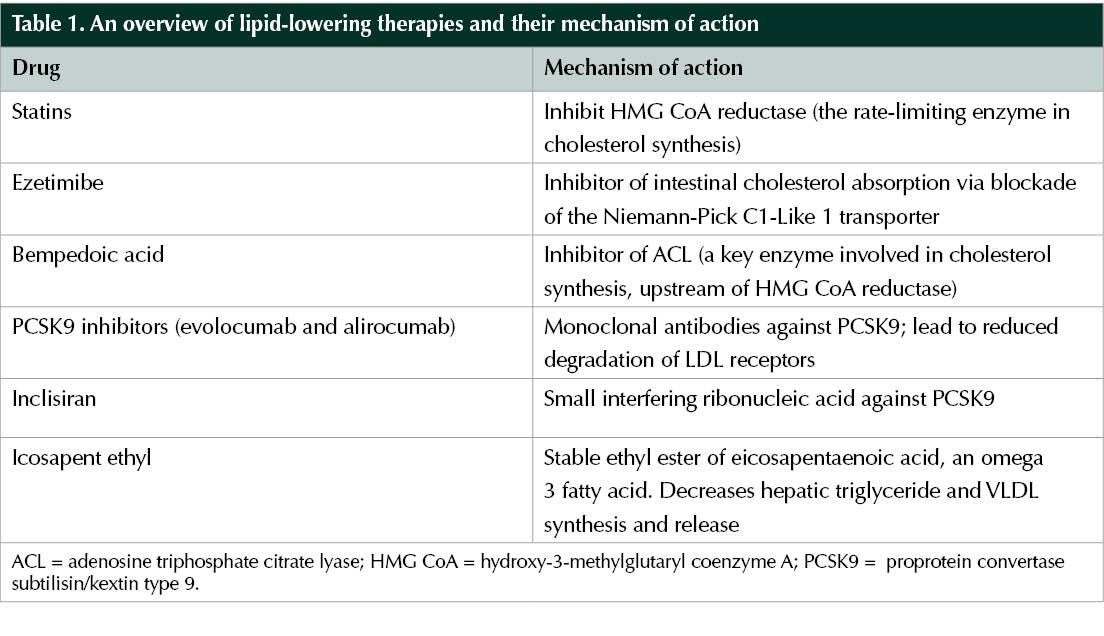
Lipid-lowering therapy should be individualised, with discussion of benefits, risks and potential side effects. Lifestyle modification remains essential, including smoking cessation and physical activity, alongside blood pressure control and optimisation of HbA1c. Table 1 summarises the mechanisms of action of commonly used lipid-lowering therapies.
Statins
Statins inhibit HMG-CoA reductase and remain first-line therapy for most patients. High-intensity statins can reduce LDL cholesterol by up to 55% (NICE, 2023). Meta-analyses show that statins reduce all-cause mortality, vascular mortality and major vascular events in patients with diabetes (CTT Collaborators, 2008). Statin therapy is also associated with reduced adverse limb outcomes in patients with PAD (Kumbhani et al, 2014).
Ezetimibe
Ezetimibe reduces LDL cholesterol by inhibiting intestinal cholesterol absorption, leading to up-regulation of hepatic LDL receptors (Chait et al, 2024). It is commonly used alongside statins to achieve target LDL levels, or as monotherapy in patients with statin intolerance. In the IMPROVE-IT trial, adding ezetimibe to simvastatin in patients with diabetes and prior acute coronary syndrome reduced myocardial infarction and ischaemic stroke compared with simvastatin alone (Giugliano et al, 2018).
Bempedoic acid
Bempedoic acid inhibits ATP citrate lyase, reducing LDL cholesterol. NICE recommends a fixed-dose combination of bempedoic acid and ezetimibe for patients who cannot tolerate statins or who do not reach targets with ezetimibe alone. In statin-intolerant patients, bempedoic acid significantly reduced major adverse cardiovascular events compared with placebo (Nissen et al, 2023).
Injectable therapies
Injectable therapies targeting PCSK9 have emerged as effective LDL-lowering options. Monoclonal antibodies (evolocumab and alirocumab) and small interfering RNA (inclisiran) increase LDL receptor expression and reduce circulating LDL cholesterol.
Evolocumab and alirocumab, administered every 2–4 weeks, reduce LDL cholesterol by up to 60% and lower cardiovascular event risk in patients with established cardiovascular disease (Sabatine et al, 2017; Schwartz et al, 2018). Evolocumab also reduces major adverse limb events in patients with and without PAD (Bonaca et al, 2018).
Inclisiran, administered at baseline, 3 months and then every 6 months, reduces LDL cholesterol by approximately 50% (Ray et al, 2020). Cardiovascular outcome data are awaited. Eligibility criteria for PCSK9 inhibitors and inclisiran are defined in NICE technology appraisals.
Icosapent ethyl
Icosapent ethyl, a purified eicosapentaenoic acid derivative, reduces triglyceride-rich lipoproteins. In patients with established cardiovascular disease and raised triglycerides despite statin therapy, icosapent ethyl reduced ischaemic events compared with placebo (Bhatt et al, 2019). NICE recommends considering icosapent ethyl for patients with cardiovascular disease, elevated fasting triglycerides and LDL cholesterol between 1.04–2.60 mmol/L.
Conclusion
Management of dyslipidaemia is an essential component of the multidisciplinary care required for patients with diabetes-related foot ulceration. Cardiovascular risk is significantly elevated in this population, and optimising lipid-lowering therapy to achieve recommended LDL and non-HDL targets is crucial. This is particularly important for patients with co-existing PAD, who may require more intensive review.
Further research is needed to determine whether intensifying lipid-lowering therapy can prevent diabetic foot disease or improve foot-related outcomes. Diabetic foot clinics provide an important opportunity to review lipid profiles and identify patients who may benefit from treatment optimisation.