
Lower extremity amputations (LEA) rates in the UK have been increasing. Between 2015-2018, major amputations (those above the level of the ankle) increased by 18.3% and minor amputations (those from the ankle and below) increased by 22.4% (Diabetes UK, 2020; Graz et al, 2018, Speer et al, 2021; Robbie et al, 2023).
The increase in minor amputations may be explained by the increase in lesser toe amputations (LTAs; Svensson et al. 2011). LTAs can avoid further lower limb amputations, especially with advances in vascular surgical techniques, including endovascular surgery (Hughes et al 2020). LTAs may be undertaken electively to reduce further complications; for example, when a toe deformity is present, or urgently for soft tissue infections, osteomyelitis or necrosis (Chu et al, 2016).
Retrospective studies have reported that 60% of people with diabetes who underwent an LTA required additional surgical intervention, either at the original amputation site or involving further amputation of the foot or leg (Jouhar et al, 2018, Speer et al. 2021, Biagioni et al, 2022; Panagonia, et al. 2023). These studies did not explore reasons for subsequent surgery or the treatments or rehabilitation that patients received postoperatively, so it is not possible to establish if these are contributing factors to further surgery.
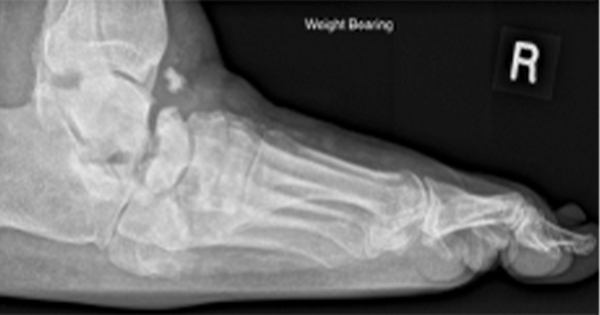
Unterfrauner et al (2023) examined X-rays of patients who had undergone a second toe amputation, and observed that both the hallux and the third toe shifted to occupy the space left by the absent second toe. The change in toe position caused ulcerations on the lateral aspect of the hallux and the medial side of the third toe in 50% of patients where the toes pressed against each other. Unterfrauner et al (2023) recommended the use of toe dividers as space-holding devices to prevent undesirable changes in toe position; however, they highlighted a lack of robust empirical evidence to support their effectiveness. In the absence of high-quality research, clinical practice has continued to be informed by experimental and anecdotal evidence, with toe dividers commonly reported as being used post-amputation to support toe alignment and positioning (Mallard 2026).
Currently there are no consensus documents or guidelines that specifically support how clinicians should treat people with diabetes after the patient has had an LTA (Metsaraht et al 2024).
Aim
The aim of this study is to identify current treatment provisions available to people with diabetes following an LTA, and to determine which healthcare professional groups deliver these interventions and what materials are commonly used.
Methods
Ethical approval
University ethical approval (SREIC/2024/047) was gained before commencing the study.
Questionnaire design
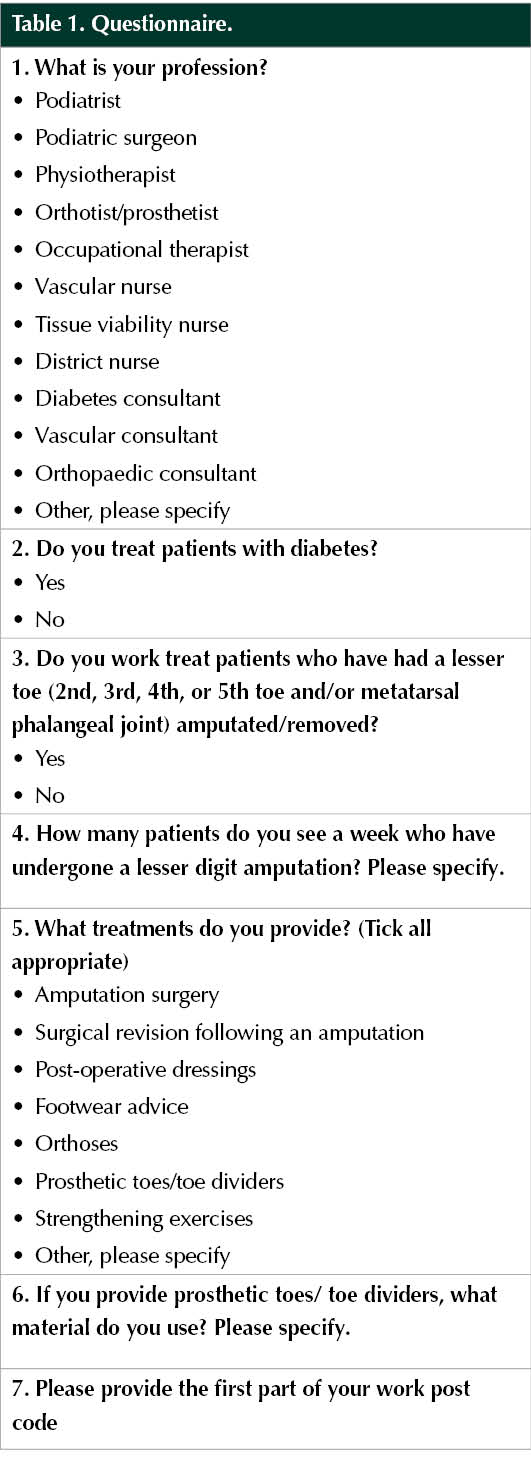
A questionnaire was developed to examine current treatment provision for people with diabetes following an LTA c (Table 1). It was distributed through the Qualtrics platform (Miller et al 2020). Its content was informed by clinical experience, evidence-based guidelines for the management of diabetic foot wounds, and existing literature on diabetic foot care and amputation (van Schie, 2005; NICE, 2019; Lepäntalo et al, 2021; Chen et al, 2023; Iijima et al, 2023; Peng et al, 2023; Unterfrauner et al, 2023; Schaper et al, 2024).
The questionnaire incorporated both open- and closed- ended items, allowing respondents to provide detailed information where relevant and select “not appropriate” where required. Multiple choice questions were included, and participants were permitted to provide more than one answer if appropriate. Consequently, the number of responses varied across individual questions. The questionnaire was piloted on a small number of healthcare professionals to assess reliability. Piloting revealed that it was not possible to determine where responses originated. This information was necessary to ensure that the results represented the whole of the UK, rather than isolated areas where clinical practice may be similar and therefore not reflective of national variation. To maintain anonymity while still capturing geographical spread, participants were asked to provide the first part of their employment postcode.
Study design and target audience
Participants recruited to the study were registered healthcare professionals (aligned to the General Medical Council, Health and Care Professions Council or Nursing and Midwifery Council) involved in the management of people with diabetes following an LTA. To maximise the diversity of professional representation, the questionnaire was disseminated through multiple channels: professional bodies, specialist interest groups on social media platforms (Facebook, LinkedIn, Instagram), specialist wound care and podiatry workshops, postgraduate cohorts within the host university, and personal invitations. Additionally participants were encouraged to disseminate the questionnaire to relevant colleagues.
Consent and confidentiality
Before completing the questionnaire, participants were asked to read a participant information letter. This outlined that no personal data would be collected and that all responses would be stored securely in a password-protected file. The letter stated that consent was implied through completion of the questionnaire and that due to the anonymous nature of the data, withdrawal would not be possible once the questionnaire had been submitted.
Results
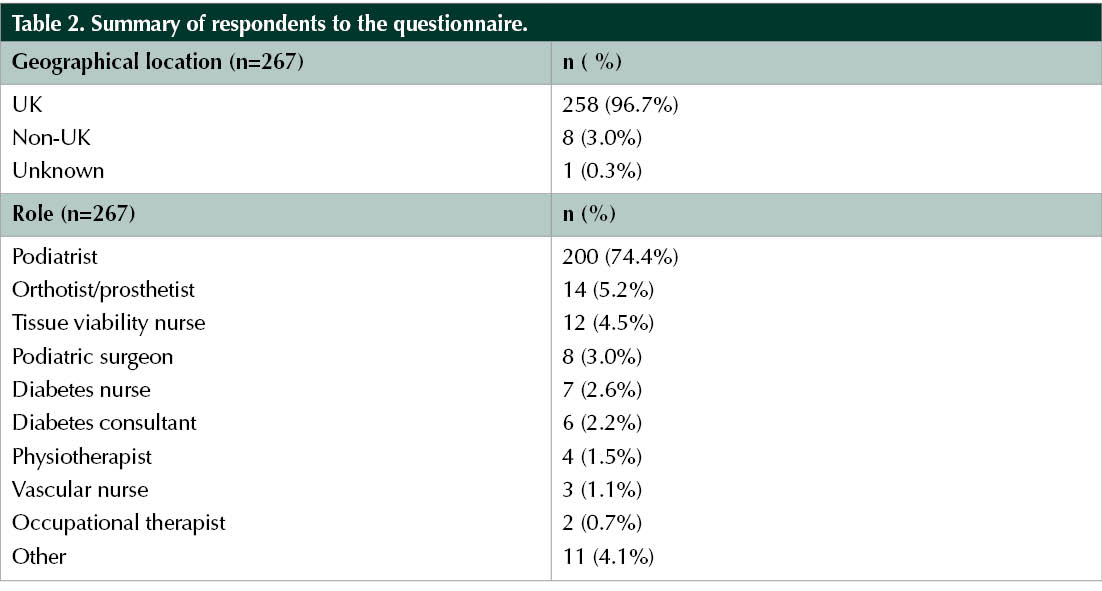
The questionnaire was open from 1 August 2024 to 30 November 2024. 267 valid responses were received. Most responses were received from the UK, with smaller numbers from Ireland, US, Australia and Malta. Most respondents were podiatrists, with orthotists/prosthetists and tissue viability nurses also represented, alongside smaller numbers from other professions. No responses were received from district nurses, practice nurses, or diabetes registrars despite the fact these groups would be involved in the care of people with diabetes following an LTA. Table 2 presents a summary of the responding sample.
Treatments provided
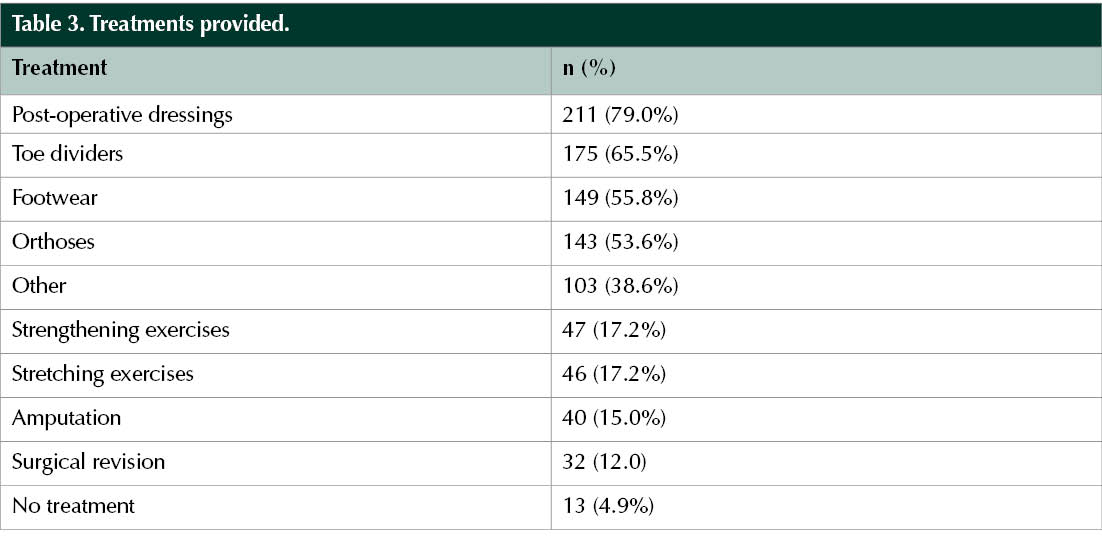
Question 5 asked about the provision of treatments. The first seven treatments were related to those recommended by the International Working Group on the Diabetic Foot (IWGDF, 2023). The treatments receiving the most responses were post-operative dressings (n=211, 79.0%), toe dividers (n=175, 65.5%) and footwear advice (n=149, 55.8%). “Other” treatments included antibiotic therapy, debridement (n=25, 9.45%) and offloading strategies (n=11, 4.25%) (Table 3).
Materials used for toe dividers
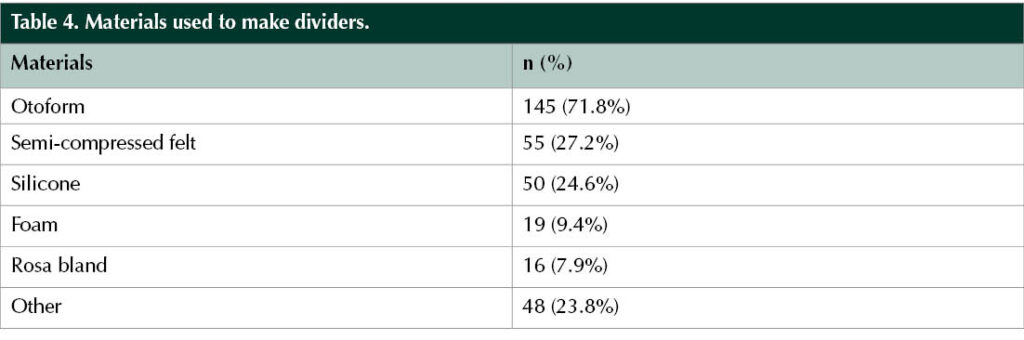
This question was completed by 202 participants. The responses were open ended and participants were able to identify more than one material. Twenty-one different materials were identified in the questionnaire. The most commonly identified are listed in Table 4. The most popular materials were Otoform (n=145, 71.8%), semi-compressed felt (SCF) (n=55, 27.2%) and silicone (n=50, 24.6%). Fifty participants stated that silicone was used to make toe dividers. This may be Otoform but also another brand of mouldable silicone with different material properties or soft gel silicone.
Discussion
This study has demonstrated that a large range of different healthcare professional roles and treatments could be involved in the treatment journey of people with diabetes requiring an LTA. Podiatrists were the largest group of healthcare professionals to respond to the questionnaire. This may reflect their central and pivotal role in managing this patient group (NICE, 2019; IWGDF, 2023).
The identification of 41 distinct treatments (with the most identified listed in Table 3) highlights the breadth and complexity of care delivered to people with diabetes following an LTA.
Post-operative dressings were the most frequently provided treatment, provided by 211 (n=79%) participants. The provision of surgical dressings aligns with recommendations of the IWGDF (2023).
Toe dividers were provided by 175 (n=65.5%) participants. This may be because respondents believe that toe dividers will help improve patient balance or reduce the risk of further ulcerations. Anecdotal evidence supports the use of silicone toe dividers to prevent digital drift and maintain the position of the toes (Landoff et al, 2020; Mallard 2026).
To the best of our knowledge, this study is the first to identify the type of materials currently used in clinical practice to make toe dividers to treat people with diabetes who have had an LTA.
Material selection appears to be driven largely by clinician preference rather than any robust evidence base. Otoform (n=145, 71.8%), SCF (n=55, 27.2%) and silicone (n=50, 24.8%) were reported as the most frequently used materials (Table 3). The predominance of Otoform probably reflects its routine use in undergraduate podiatry programmes for teaching orthodigital device manufacture (Landoff et al, 2020), rather than any proven clinical evidence. This reliance on training-driven familiarity raises concerns about whether material choice is being guided by habit rather than evidence informed decision making. Clinicians such as diabetes and vascular consultants who use Otoform appear to have acquired these skills informally in practice, highlighting a lack of standardised training and broader inconsistency in clinical approaches.
Practical and organisational factors may influence material selection. Clinicians’ choices may be constrained by the materials supplied by their Trust and those available at the time of a patient’s appointment.
NHS Trusts procure materials through a centralised ordering system, the NHS Supply Chain, within which alternative mouldable silicones are not as readily available. As a result, limited access to alternative materials may further reinforce the continued use of Otoform in clinical practice.
SCF was the second most used material. It is inexpensive, widely taught in undergraduate podiatry and orthotists programmes, and readily accessible through NHS supply chains and other medical suppliers. However, NICE (2019) recommends that SCF should be used only as a last resort.
In some clinical contexts, such as remote community clinics, SCF may be the only material available, and it can be argued that short-term use is preferable to providing no offloading at all (NICE, 2019). Despite guideline recommendations, SCF remains widely used, with 55 participants (27.23%) reporting its use. These findings concur with Rumanes et al (2025) who found that SCF was the most used material in the management of foot ulcerations in outpatient clinics. Evidence regarding its clinical effectiveness is mixed: some studies suggest that SCF does not provide adequate offloading and evidence for use on its own is weak (Armstrong et al, 1995; Fernando et al 2022, Lazzanini et al, 2023), whereas others report reductions in plantar pressures (Zimney et al, 2003; Raspovic et al, 2016; Tong et al, 2025). Although one study reported a reduction in plantar pressures with SCF and attributed this to its adherence to the foot, preventing removal and potentially enhancing effectiveness (Fernando et al, 2021; Withers et al, 2023), this explanation remains mainly speculative and unsupported by robust comparative data. Indeed, SCF has been associated with an increased risk of infection, as it readily absorbs exudate and debris can accumulate on its adhesive backing (Ho et al, 2013). These findings raise concerns about the routine use of SCF, particularly given the absence of high-quality evidence demonstrating its safety, durability, or clinical superiority. The reliance on such materials despite known risks highlights a broader lack of evidence-based guidance in this area of practice.
Strengths
There are no previous published studies describing individuals or modalities of treatment post LTA, to the best of our knowledge.
The survey was disseminated across multiple platforms, resulting in data capture from a diverse sample.
Limitations
The questionnaire did not capture input from all healthcare professional groups involved in the care of people with diabetes following an LTA, meaning the perspectives of several key professions are absent, e.g. district nurses and registrars. The reasons for non-responses to the surgery remain unknown, raising concerns about potential sampling bias and the extent to which the findings reflect the full multidisciplinary landscape.
Conclusion
The study met its primary aim of identifying current treatment provision for people with diabetes following an LTA. The study found a wide and varied range of post-operative treatments provided and there was no consistency to the materials used. What is still unknown is which treatments are beneficial or detrimental to the people with diabetes following an LTA. Very few of the treatments and materials identified have an evidence base to support their use. Although general offloading guidelines, such as IWGDF, NICE and local trust guidelines, are in place, there are no evidence-based or best practice-based guidelines currently available that only provide advice on how best to manage people with diabetes who have LTAs to support clinicians in clinical decision-making.
Further research is needed to strengthen the management of this patient group, streamline treatments provided to people with diabetes and an LTA and establish a robust evidence base to guide clinical decision-making.