Diabetic foot complications, such as ulcers and osteomyelitis, can lead to higher frequencies of amputation and mortality (Boulton et al, 2005; Armstrong et al, 2017). Such complications are most encountered in the forefoot region; however, those located on the toes and, particularly, on the distal toe part are rarely investigated (Faglia et al, 2012; Ulcay et al, 2014; Baek et al, 2018). As well as the occurrence of wounds, the distal part of the toes can be subject to calluses and deformities which can, in turn, lead to ulcers.
Toe deformities, including hammer toes, claw toes and mallet toes are common in patients with diabetic neuropathy, and can be precursors to the development of callus or ulceration on the distal aspect of the affected toes (Coughlin, 2002; Shuman et al, 2006). Claw deformity, the most frequent type in this population (Cavanagh et al, 2010), is defined by a flexion deformity of the proximal and distal interphalangeal joints (DIPJ) in lesser toes, or the interphalangeal joint (IPJ) of the hallux. Initially flexible, these joints become fixed over time which leads to increased pressure on contact zones. Two areas are usually subject to higher pressure in the distal toe part: the pulp/ plantar or distal (tip) zones, and the dorsal aspect of the DIPJ/IPJ; these areas bear the risk of developing calluses and ulcers (Boulton, 2004).
While standard of care based on in-office debridement, topical agents and off-loading the pressurised zone can help wound healing and infection control, removal of the causal factor is essential for curative treatment. To this, many surgical procedures are indicated to alleviate or eliminate the distal toe pressure causing calluses and/or wounds. Conservative surgery has shown efficacy when treating non-complicated and complicated diabetic ulcers (Ha et al, 1996; Piaggesi et al, 1998). With respect to toe location, conservative procedures have yielded excellent outcomes in terms of healing frequency (98.3%), healing time (6.8 ±3.9 weeks), recurrence frequency (2.3%), wound complications (9.2%) and revision surgery (7.4%) (Yammine, 2020a).
However, the literature reporting on the surgical techniques and outcomes is scarce, with no clear guidelines in relation to procedure indication. Therefore, the aim of this review is to describe some of the most used techniques and indications, and the existing evidence supporting their use.
Method
We conducted a literature search using two electronic databases: PubMed and Scopus. The search included any type of study or review reporting surgical techniques, indications and outcomes of conservative surgery for the prevention and treatment of diabetic forefoot complications. No limitations were imposed on study design. When available, data specifically related to the distal toe were extracted. The distal toe was defined as the part of the toe located at, or distal to, the distal interphalangeal joint (for lesser toes) or the interphalangeal joint (for the hallux).
Results
The electronic search resulted in 141 studies where 12 were eliminated for duplication. After title and abstract screening, 26 studies were deemed to be potentially relevant. The full manuscripts were checked and 14 studies (Rosenblum et al, 1994; Martin et al, 1997; Rasmussen et al, 2013; van Netten et al, 2013; Boffeli et al, 2014; Lew et al, 2015; Tamir et al, 2016; Boffeli et al, 2018; Schmitz et al, 2019; Löndahl et al, 2021; Ehredt et al, 2023; Yammine, 2024a; 2024b; Yammine et al, 2024;) met our inclusion criteria and were retained.
The following three common types of procedures are available to treat diabetic distal toe complications:
- Distal resection arthroplasty.
- Distal Symes amputation.
- Percutaneous toe flexor tenotomy.
Distal resection arthroplasty
Distal interphalangeal joint resection arthroplasty is mainly used to treat plantar/pulp wounds located over the proximal aspect of the distal phalanx of the hallux. While earlier studies reported the excision of half of the proximal phalanx (Rosenblum et al, 1994), the current technique aims to remove just the head using either a burr (Ehredt et al, 2023) or a saw (Martin et al, 1997; Lew et al, 2015). Some authors recommended temporary fixation using k-wires but offered no clear guidelines with respect to the indication (Martin et al, 1997; Lew et al, 2015). Outcomes following this surgery in the hallux were reported to be good to excellent: mean healing frequency (92.3%), mean healing time (2.9 ±0.6 weeks), ulcer recurrence frequency (6%), ulcer transfer frequency (2%), post-operative infection rate (11%) and revision surgery rate (2.5%) (Yammine et al, 2024) Less frequently, a distal resection arthroplasty could be indicated for dorsal ulcers of the DIPJ on a lesser toe with mallet deformity.
Distal Symes amputation
This procedure attempts to preserve as much distal soft tissue of the lesser toes as possible in order to maintain maximal length (Boffeli et al, 2014; Tamir et al, 2016; Boffeli et al, 2018). The main indication is an infected ulcer of the pulp associated with osteomyelitis of the distal phalanx. It includes the excision of the wound, the nail complex and the distal phalanx. If septic arthritis of the DIPJ was present, or the infection was suspected to have spread more proximally based on magnetic resonance imaging, excision of the distal part of the middle phalanx was included (Yammine, 2024a). The incision aims to create a dorsal and a larger plantar flap. In case the status of the soft tissues permits a narrower excision of a centrally located ulcer, a U-T flap could be used to close the wound in an esthetical and tension-free manner (Yammine, 2024b).
Toe flexor tenotomy
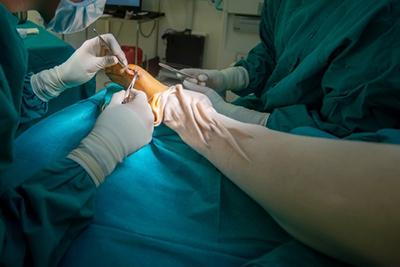
Flexor tenotomy was used either to prevent or to treat calluses or ulcers. Through a stab wound or percutaneously with a needle, the flexor tendon(s) is (are) cut to release the fixed flexion of the distal toe. Incision sites vary widely, mainly depending on which flexor is to be cut. The long flexor could be severed at any level of the toe to treat or prevent a non-infected pulp ulcer/callosity (van Netten et al, 2013; Schmitz et al, 2019). However, when a deformity is present, a targeted cut at the level of the deformity is required. For hammer/claw toe, this involves a proximal cut around the level of PIPJ of the long flexor; for mallet toe, a distal cut at the level of the DIPJ is necessary. A proximal incision at the base of the proximal phalanx or at the distal flexor crease is needed if both flexors need to be cut (Rasmussen et al, 2013; Löndahl et al, 2021). In the latter case, a tenotomy proximal to the chiasm could generate a more complete release due to the intertendinous connections between FDL and FDB present distal to the chiasm (Yammine, 2024a).
Discussion
Callosities and ulcers of the distal toes are usually caused by increased pressure due to deformity of the toe. The increased pressure will induce hyperkeratosis and the formation of a callosity. Any callosity could be the precursor of a wound which could lead to soft tissue infection and osteomyelitis. Foot deformities, mainly toe deformities, are highly prevalent among people with diabetes, with or without diabetic neuropathy (DN) (Formosa et al, 2013; Esther et al, 2021; Adebabay et al, 2022). Some studies found a correlation between the presence of DN and deformity frequency (Esther et al, 2021). Independently of DN presence, the most frequent deformities are hallux valgus and hammer/claw toes, which could affect almost half of the patients. In addition, more than half of people with diabetic foot deformities presented with unsuitable footwear in primary care settings (Formosa et al, 2013). Wearing inadequate footwear increases the risk of developing diabetic foot deformities two-fold when compared with those wearing adequate footwear (Adebabay et al, 2022).
Conservative surgery for diabetic foot ulcers and infections of the forefoot has been shown to yield excellent results (Yammine et al, 2020a,b). When compared to standard of care, surgical bony offloading procedures demonstrated significantly better outcomes for wound/infection healing, healing duration and recurrence (Yammine et al, 2020b; 2020c). The time period for considering surgical treatment for patients with non-healing diabetic foot wounds should not be long; it has been suggested that a cut-off value of 12 weeks of standard of care is sufficient to warrant surgical management (Yammine et al, 2020c).
A decision-making tool has been developed to assist healthcare providers in making surgical decisions when treating diabetic forefoot ulcers and infections (Yammine et al, 2020b). Based on this tool, we developed a modified algorithm adapted to the management of ulcers, callosities and infection of the distal toe (Figure 1). This algorithm depends on the involved toe and the location of the deformity. For the hallux, where ulcers are often situated on the plantar aspect of the pulp near the IP joint, a resection arthroplasty could be performed when osteomyelitis is present. Callosities, non-infected and infected ulcers of the distal tip could be managed similarly for all toes; either with flexor tenotomy for callosities and ulcers without osteomyelitis of the distal phalanx, or via a distal Symes amputation when bone infection is present. The level of flexor tenotomy usually depends on the deformity. For claw and hammer toes, the tenotomy could be conducted at the level of mid-middle phalanx or proximal phalanx to sever the long flexor or both flexors. For mallet toes, the long flexor is cut at the level of the DIPJ.
Conclusion
This study focused on the available surgical techniques and indications for the treatment of distal toe complications in people with diabetes. Depending on the complication location and whether an osteomyelitis is present, specific toe-sparing procedures were discussed and a surgical algorithm was suggested, to assist in identifying proper indications.
Ethical approval
Ethical approval was obtained from the Institutional Review Board (LAUMCRH.KY2.25/Nov/2020).Informed consent statements were obtained from the patients.